
Historical research is ongoing. This page was last updated on 18 August 2026 and will be expanded as further records, photographs and memories are contributed.
Decade Overview
The Birth of a Club and a Movement
The story of Portlaoise GAA begins against the backdrop of a changing Ireland. During the late nineteenth century, Ireland remained part of the British Empire, and British sports such as rugby, cricket, athletics and soccer were becoming increasingly popular throughout the country. At the same time, many feared that Ireland's own language, customs and traditional pastimes were being lost amid growing anglicisation.
In response, a powerful cultural revival emerged across Ireland. Interest in Irish language, literature, history and identity grew alongside political movements seeking land reform and greater self-determination. It was during this period of national awakening that two influential figures, Michael Cusack and Maurice Davin, sought to establish an organisation dedicated to preserving and promoting Ireland's native games.
On 1 November 1884, a meeting in Hayes Hotel, Thurles led to the foundation of the GAA. With Maurice Davin elected as its first President and Michael Cusack as Secretary, the new organisation set out to organise and promote Irish athletics, hurling and football. Built around the parish and county structure that remains familiar today, the GAA spread rapidly throughout the country, establishing clubs in towns and villages across Ireland.
Laois was represented in the Association from its earliest years, and Maryborough, now Portlaoise, quickly became one of the pioneering centres of Gaelic games in the county.
The foundation meeting in the Town Hall
The inaugural meeting of Portlaoise GAA Club took place in the Town Hall on Monday 28 November 1887. It was a public meeting called by placard and attracted a large attendance from across Maryborough, now Portlaoise. Among those present were Dr Higgins, coroner for Queen’s County, who presided, along with N. Walsh T.C., P.A. Meehan T.C., C. McDermott T.C., P. Kelly T.C., T. Lawlor T.C., C.E. Corcoran, solicitor, Mark Walsh, J. Moore, P.J. Hegarty, R.P. Fennell, P. Fitzpatrick, M. Brophy and J.T. Delaney.
Opening the meeting, Dr Higgins described the formation of a branch of the Gaelic Athletic Association in Maryborough as “a very desirable movement” and said it was time for the town to follow the example of other important towns across Ireland. He stated that the district possessed athletes equal to any in the country and believed they would prove themselves once given the opportunity under the Association.
R.P. Fennell outlined the aims of the GAA and stressed that it was a non-political and non-sectarian organisation. P.A. Meehan proposed the first resolution “that a branch of the Gaelic Athletic Association be hereby established in the town and that it be called the William O’Brien Branch”, a reference to nationalist figure William O’Brien who was imprisoned in Tullamore Jail at the time. The motion was seconded by Mr Kelly and passed by the meeting.
Dr Higgins was elected president and C.E. Corcoran vice-president. R.P. Fennell became secretary while J. Moore was elected treasurer. During the meeting there was also strong criticism of attempts to divide the Association at Thurles earlier that year, reflecting the determination locally to support and strengthen the new GAA movement.
In closing the meeting, Dr Higgins stated that it had always been his wish and duty to advance “the interests of the National cause” in Maryborough and remarked that the town had long been prominently associated with that movement. His remarks were received with enthusiastic applause. That evening in November 1887 marked the beginning of what would become one of the most important sporting and community institutions in the town.
Chairman: Dr. Higgins and N. Walsh C.T.C.
County Convention
Maryborough (Portlaoise) was represented at a County Convention in Abbeyleix on Sunday, 11 December 1887, and fifteen of the nineteen clubs in Laois sent two delegates. Mr P. A. Meehan, Maryborough, was moved to the chair. He anticipated that when the Queen’s County (Laois) went into the sporting field they would be able to hold their own in friendly contest with any other county as they had already done in the political field (hear, hear).
Elections resulted as follows:
President: John McMahon, merchant, Abbeyleix; Vice-President: P. J. Maher, Knock; Treasurer: J. Walsh; Secretary: D. O’Rourke, Durrow; Committee: A. O’Rourke, M. C. Hayden, C. Comerford, J. Maher, W. Delany, W. Dunne, T. Breene.
Delegates to attend Thurles Convention: J. Fitzgerald (Rathdowney) and J. Maher (Ballinakill).
The meeting was, however, deemed “informal” by the GAA executive and a second convention was held a few weeks later in the Commissioners’ Room of the Town Hall, Maryborough, on Sunday, 1st January 1888.
The following thirteen clubs were represented:
Abbeyleix: J. McMahon, G. Harte; Barna: P. Cashen, P. Maher; Ballinakill: J. Maher, P. Comerford; Cullohill: A. O’Rourke, R. Roberts; Durrow: D. O’Rourke, M. Holohan; Derrykearn: P. Phelan, W. Phelan; Gourteen: J. Loughman, P. Brien; Knock: J. Walsh, P. J. Maher; Knockaroo: J. McEvoy, S. Loughman; Killasmeesthia: M. Blunett, M. Loughman; Rathdowney: J. Fitzgerald, R. Ryan; Wolfhill: T. Breen, J. Fleming; Maryborough: R. P. Fennell, C. McDermott, T.C.
Mr. J. Breen, of Wolfhill, was moved to the chair. Mr. D. O’Rourke, Durrow, was appointed secretary.
Mr. Breen said that everything was creditably done at the Abbeyleix meeting. The Ballinakill delegate, Mr. P. Comerford, asked why the Abbeyleix meeting was deemed irregular and said his club protested strongly about the procedure but did not wish to create any dissension about the matter.
The secretary, Mr. D. O’Rourke, explained that he had been in contact with Mr. Davin (first GAA President) and had been told that some of the clubs that attended the Abbeyleix meeting may not have been formally affiliated and recommended a second meeting to put this right.
Mr. Breen read the instructions sent down from the GAA executive to the effect that only clubs affiliated before the 1st November 1887 “were entitled to hold convention and be represented thereat”. Mr. McEvoy said they were assembled there under the rules of Mr. Davin and to see that all the clubs carried them out properly.
Mr. Fennell, on behalf of the Maryborough club, claimed the right to be represented as the proper steps had been taken with reference to affiliation. The Leinster Express, 7th January 1888, reported Mr. Fennell’s submission:
On 24th October last a club had been formed in Maryborough and two delegates were appointed to attend the late Thurles Convention. They forwarded the affiliation fee of 10s. to Mr. O’Reilly, the honorary secretary, but although several letters had been sent to him, he would not reply or forward a receipt. The result was that Maryborough was not represented at Thurles at all. Subsequently Mr. Fennell wrote acquainting Mr. O’Reilly that Maryborough had seceded from the association and demanding that the money be refunded. The money was sent back. On these grounds Maryborough was entitled to be represented at that convention as the club had not been fairly treated in the matter.
Mr. Fennell’s assertion that the club was formed on 24th October 1887 would indicate that there had been an earlier meeting called than the one recorded above on the 28th November of that year. It may have been an informal meeting called to meet the affiliation deadline for the Thurles Convention and to make arrangements for the big public meeting a month later at which the club was officially formed.
There are no records available of the meeting referred to by Mr Fennell but the County Convention was satisfied, nevertheless, that Maryborough had fulfilled the necessary requirements for affiliation and it was unanimously decided that the Maryborough Club was entitled to be represented.
Despite objections, a letter from Fr. Scanlan, C.C., Nenagh, was brought to the attention of the meeting. It read:
“Nenagh, December 28th, 1887.
Sir, - Out of the delegates to National Council select one (or two) for central council or court of appeal. Interchange the names with the other friendly counties in order to secure mutual support at convention. Beware of Cork and Limerick; the two for Tipperary are Maurice Davin and Dr. Daly.
Yours &c.,
John Scanlon, C.C.”
There was no comment on the letter and the convention proceeded to the election of president.
Mr. P. Ryan proposed, and Mr. McEvoy seconded, that Mr. P. A. Meehan be appointed president. Mr. P. J. Maher proposed and Mr. A. O’Rourke seconded the appointment of Mr. J. McMahon. Mr. Meehan won the contest by a single vote, 16 to 15, to become the county’s first president (later chairman). In effect he became the first officially elected chairman of Laois GAA.
Mr. D. O’Rourke, Durrow, was elected secretary, and Mr. J. Walsh as treasurer. Mr. J. Maher, of Ballinakill, was selected to represent the county at the Thurles convention. Committee: J. Fitzgerald, J. Breen, J. McMahon, P. Comerford, J. McEvoy, W. Phelan, A. O’Rourke, M. Loughman.
Mr. J. McEvoy proposed a vote of sympathy with Mr. O’Brien and Mr. T. D. Sullivan, “now incarcerated under the Crimes Act in Tullamore prison. The Irish people would never stop agitating until the dark cloud of oppression was swept away, and the green flag floated over College Green, to denote that Ireland had succeeded in winning back her native Parliament (hear, hear)”. Mr. O’Rourke seconded and the resolution was unanimously passed.
Eighty delegates attended the Convention in Thurles on Wednesday, 4th January, 1888. The Leinster Express report on the meeting was very brief. “There were rival sets of delegates from several places, and the vote, with official Catholic Church backing, went according to expectations and the clerical or anti-Fenian party had the advantage”.
Archbishop of Cashel, Thomas William Croke, first Patron of the GAA, was not present at the meeting but sent a letter with recommendations which were adopted. He advised that
drink should not be sold at or near their athletic meetings; that meetings should not be held near public houses; that prizes should not be accepted from publicans who offer them to attract customers; that county and district meetings should not be held on Sundays, because those who attended them often neglected Mass and catechism for the purpose; and that parochial athletic Sunday meetings should not be held until after two o’clock p.m.
Dr. Croke’s reservations were re-emphasised and expanded upon in the Lenten pastoral of the Catholic Primate of All-Ireland, Archbishop of Armagh, Michael Logue. In a lengthy report on the matter in the Leinster Express dated 18 February, 1888 the Primate said that laudable as the GAA’s object was (in promoting sports of Irish manhood), in some parts of his diocese little regard was taken of Dr. Croke’s regulations.
Having condemned the people who took part in games at times and places excluded by the regulations, the Primate added:
Nor is the evil confined to those actually engaged in the game, they draw after them the children of both sexes, thus depriving them of instruction in the catechism. Yes, and they draw after them too, foolish old men, who would be much better employed counting their beads in a quiet corner of the church, and preparing for the end which is so close upon them.
He then lashed out at the danger of intemperance.
It is evident such a profanation of the Sunday and turning away of the people from their religious duties, to which the chief part of the day should be devoted, can no longer be tolerated. Hence I exhort the clergy to set their faces against this abuse, and neither to countenance, nor as far as in them lies, tolerate any athletic club in their parishes that will not keep at the very least within the lines of the rule laid down by his Grace, the Archbishop of Cashel.
Maryborough’s first reported games
The first reported game involving the newly formed Maryborough club appeared in the Leinster Express following a friendly football match against the recently established Portarlington side on Sunday, 4 November 1888. The game took place on grounds situated close to Odlum’s Mill and adjoining the railway station in Portarlington.
Maryborough proved too strong and recorded a convincing 1-6 to 0-0 victory. Local man George Copeland acted as referee and according to reports performed his duties “to the satisfaction of all concerned”. Afterwards, the visitors were entertained by Portarlington in the “Dramatic Room” of the Catholic Young Men’s Society, with both clubs finishing the evening amidst cheers for the GAA.
A fortnight later on Sunday, 18 November 1888, Maryborough faced Clonad in what became the first recorded meeting between two clubs who would later develop one of Laois hurling’s great rivalries. Played on a field at Meelick kindly provided by Mr M. Corcoran of Maryborough, reports praised the football but criticised some of the conduct during the game, highlighting how fiercely competitive Gaelic games had already become in the county’s earliest years.
The club’s development continued into January 1889 when Maryborough staged a major triple fixture day featuring football, juvenile football and the first reported hurling outing in club history against Ballytarsna. Maryborough again defeated Portarlington in football by 0-5 to 0-0 before the juvenile side also recorded victory.
Though the hurlers lost 2-6 to 0-0 against a much more experienced Ballytarsna team, reports praised the “plucky performance” of the Maryborough players on their first appearance. Among those singled out for good displays were W. Fitzpatrick, James Reilly and P. Whelan, while team captain John McGuire received particular praise for guiding the fledgling side.
Maryborough v Portarlington
MARYBOROUGH 1-6
PORTARLINGTON 0-2
On Sunday last the Maryborough Gaels journeyed to Portarlington to meet the recently formed Portarlington Football team and were warmly received by their hosts at the rooms of the Catholic Young Men's Society.
The field of play was situated close to Messrs. Odlum's mill and, owing to the recent wet weather, the ground was somewhat heavy. Play commenced at about 3.15 p.m., with the wind slightly in favour of the visitors.
Maryborough soon placed a point to their credit and continued to hold the advantage until half-time was called, the ball rarely leaving their opponents' ground.
In the second half the visitors started with an advantage accidentally given them by the referee, from which, however, they failed to score.
During the remainder of the game the Portarlington men played with determination and, through several promising attacks, came close to scoring, but the splendid defence of the visitors repeatedly thwarted their efforts.
Result: Maryborough 1 goal and 6 points, Portarlington 2 points.
Mr. Copeland of Portarlington discharged the duties of referee to the satisfaction of all concerned.
The visitors were hospitably entertained after the match by the Portarlington team in the Dramatic Room of the Catholic Young Men's Society and left after spending a most enjoyable evening amid mutual expressions of goodwill.
The 1889 Championship Campaign
In the first round of the county championship, Maryborough’s William O’Brien’s were pitted against Timahoe’s Round Towers at Knock. The Leinster Express reported:
The Maryborough men in their handsome uniform, were thought to be unlikely to stand long before the stalwart fellows from the Round Tower … from the throw-in Joe Tehan … was barely collared in time to save a goal, where a most determined attempt was made to score; the players rushed the goal en masse and, after a scrummage of several minutes duration, Timahoe succeeded in kicking out the leather to neutral ground, where it remained for a quarter of an hour until Delany (capt.) by a well-directed kick placed a point to the credit of the ‘White and Green’.
This gave fresh courage to his men, and by skilful play, two points more were added … near half-time a Timahoe man kicked the ball in the direction of his own goal line and it would have crossed it had not the bystanders been over the line, and the ball striking against them, made a forty yard kick for the O’Briens.
The referee asked the opinion of a member of Knock GAA who was standing close to where it went out, and he confirmed the above, but as the referee did not see it himself he decided to throw up the ball at the place from which it was kicked. The throw-up was within ten yards of the goal, and on it leaving the referee’s hands, Timahoe captain, Mahon was in the act of catching it when he was shouldered by J. T. Whelan (vice-captain) of Maryborough who caught it himself and kicked it under the crossbar amidst the cheers of the spectators.
Half-time: Maryboro’ 1 goal and 3 points to nil.
Timahoe, the stronger team, came at Maryborough in the second half but could only manage two points and a “disputed” point. Mr. P. J. Maher, Knock, was referee and umpires were Mr. Brady, Timahoe, and Mr. McGuire, Maryborough.
In the other game at the same venue, featuring Abbeyleix and Ballyroan, the result remained undecided as the referee had the scores at four points each. The referee called for thirty minutes of extra time but the Ballyroan umpire refused to allow his team to play because he maintained that his team had scored five points.
A third game on the programme was not played because Carlow-Graigue failed to turn up and Kilcruise were awarded the game. Branra beat Durrow by one point in another first round game.
Second Round
In the second round (or ties as they were called) Wolfhill beat Barna by one goal and one point to one point. Maryboro’ met Boley. Both teams scored one point apiece and just before half-time Boley drove the ball under the crossbar. Although the whistle had been blown prior to the kick for a dead ball and the Maryboro’ men were not defending their line, the score was allowed.
Maryboro’ managed five points in the second half and held their opponents scoreless, which meant it was undecided as a goal in those dim and distant years equated to five points. Mr. S. J. Muldowney, Branra was referee.
Maryboro’ maintained that they won the game and objected but the county board ordered a replay. This was played on Sunday, 12th May, at Abbeyleix. Having won the toss, Maryboro’ opted to play with the wind but failed to score until just before half-time when they got a point and then a goal. There were no scores registered after that and Maryboro’ were through to the next round.
Third Round and Appeal
The third round presented yet tougher opposition again with opponents, Branra, “composed of eight of the crème de la creme of the Ballinakill club that won the championship in the previous year”. The result was Branra one point and one disputed point to Maryboro’s one point.
The game was ordered to be replayed by the county board and Branra were ordered to play without the Ballinakill players. The “bonnie boys in blue” failed to turn up for the replay at Abbeyleix and referee, John J. Walsh, Knock, awarded the game to Maryboro’.
Branra appealed the result to the Central Council, who held a meeting in the Irish Forester’s Hall, Dublin, and decided that they should not interfere with the decision of the county committee.
Wolfhill beat the Heath 2-2 to 0-5 in another game on the same programme. A third game between Knock and Abbeyleix was called off due to a dispute.
Stradbally beat Pallas by 0-3 to 0-1 in a game played at the “Heath of Maryborough”. Ballyroan beat Knock in another by 1-1 to 0-2.
Maryboro’ beat a fancied Ballyroan side in the semi-final by three points, one disputed, to no score. Drennan, King and Tom Cushion were names mentioned. Mr. W. O’Kennedy, Monasterevan GAA, was referee and John McGuire, secretary of Portlaoise GAA was an umpire. Edward O’Dea was umpire for Ballyroan.
The County Final of 1889
The final against Wolfhill took place on Sunday, 28 July 1889, in Mr. Webber’s demesne in Kellyville “which was kindly put at the disposal of the Kellyville Gaels”. There was a huge and representative crowd from all over the Queen’s County present to witness this exciting match. The Leinster Express reported:
Both teams were in good hope of victory and any superiority in form was certainly exhibited by Wolfhill, who were without doubt the better kickers, but they could not equal the smart scientific play of the Maryborough men.
Each of the teams has a good record to their credit, neither having been beaten within the past twelve months. For this year’s championship, Wolfhill has beaten Killesmeesthia, Kilcruise, Barna and the Heath; and Maryborough has been awarded matches against Timahoe, Boley, Branra and Ballyroan.
The grounds were well laid out and admirably adapted for football, and the weather was all that could be desired. Great credit is due to the Kellyville boys for the order they maintained throughout the day. Although the match was announced to commence at three o’clock, it was after four when play began.
Wolfhill scored an early point and then “Maryborough took the leather into the ‘Mountaineer’s’ ground and after sharp tussling on both sides, the ball was once again brought into the Maryborough grounds and a second point scored for Wolfhill”.
Maryborough went into attack and the ball “having been struck against the Wolfhill goalposts was sent back to the middle of the field”. There were no further scores in the opening half and the report commented that things looked “blue” for the Maryborough men at the break.
On the restart, however, Maryborough went on the offensive and Delany, the captain, scored an excellent point from a forty yard kick (free). The Leinster Express report added:
This seemed to rouse the latent energy of his men and going for the leather in faultless style, they quickly equalised the score. The excitement of all present from this to the finish was simply indescribable.
Maryborough got a second forty which was well kicked but misdirected. If possible this made the excitement even more intense. The players on both sides put their best leg forward.
Maryborough, amidst tremendous cheering, sent the leather between the point posts about ten minutes before full time and succeeded in keeping the ball well on their opponents to the finish, and when the referee called ‘time up’ Maryborough were declared the champion football team of the county amidst a very perfect shower of applause.
Result: Maryborough 0-3 to Wolfhill 0-2.
The correspondent’s euphoria was not quite finished.
The match was undoubtedly the fastest played in the county since the establishment of the GAA, and it was the general belief that if Maryborough had not been so confident of victory, they would have more readily won the laurels which they now so popularly hold, but their opponents were not so easily put down as the Maryborough men anticipated.
The referee was Mr. John J. Walsh, captain Knock GAA and Field Umpires were Mr. Thomas Breen for Wolfhill and Mr. John McGuire, hon. sec. Maryborough GAA.
Maryborough: John Delany (captain), Joseph Tehan (goalkeeper), Joseph Dunne, John Whelan, Thomas Holohan, Thomas Cushion, Daniel Cushion, Michael Cushion, Patrick Cushion, John Connor, Thomas Shiel, Joseph Murphy, John Kennedy, Daniel Drennan, William King, John Troy, Patrick Brady, Thomas Conroy, James Fleming, Joseph Walsh, Nicholas Maher.
Wolfhill: Jeremiah Keeffe (captain), Owen Smith (goalkeeper), John Fleming, William Fleming, Patrick Brennan, William Brennan, Peter Brennan, James Brennan, Michael Brennan, Michael McGrath, Thomas Dunne, John Keogh, Abraham Hennessy, William Ryan, Patrick Ryan, Michael Conlan, John Lalor, Michael Smith, Denis Finch, Patrick Whelan, Patrick Bracken.
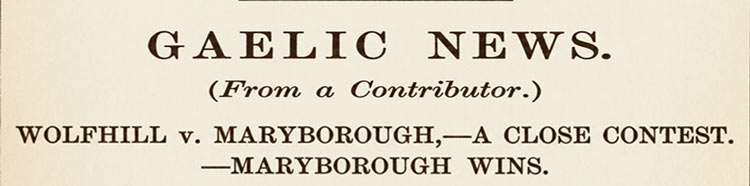
Wolfhill v Maryborough – A Close Contest – Maryborough Wins
At last the final tie for the Queen's County Football Championship has been decided. Maryborough met Wolfhill on July 28 at Kellyville, on the grounds placed at the disposal of the Kellyville Gaels, before a large and representative gathering of sporting followers from throughout the county.
Both teams entered the contest with strong claims. Wolfhill were regarded by many as the better kicking side, but their opponents were noted for their determined and skilful play. Neither team had been beaten within the previous twelve months and both had enjoyed impressive championship campaigns.
Wolfhill had accounted for Killesmeestia, Kiloorise, Barna and The Heath on their way to the final, while Maryborough had defeated Timahoe, Boley, Branna and Ballyroan. The grounds were well laid out and admirably suited for football, while the weather was all that could be desired.
Although the match was announced for three o'clock, it was after four before play began. From the throw-in Wolfhill immediately carried play into the Maryborough half and quickly succeeded in registering the opening score. They added a second point shortly afterwards and held the advantage for most of the first half.
Maryborough battled hard but could make little impression on the Wolfhill defence. At the interval Wolfhill led by 2 points to nil, though Maryborough had the advantage of the choice of ends for the second half.
On the resumption Maryborough immediately attacked and after about five minutes were awarded a forty-yard free. Delany converted the opportunity to score an excellent point, reducing the deficit and inspiring his teammates.
The score appeared to awaken Maryborough and they began to play with greater confidence and determination. Their passing and combination improved considerably and they soon succeeded in drawing level.
The excitement amongst the spectators was intense as both sides fought desperately for the winning score. Maryborough were awarded another forty, which was well struck but failed to register.
As the closing stages approached, the pace and excitement increased. Maryborough continued to press and, amid tremendous cheering, finally sent the ball between the posts for what proved to be the winning score approximately ten minutes from full time.
Wolfhill attacked strongly in search of an equaliser but the Maryborough defence held firm. When the referee finally called time, Maryborough were declared champions of the county amid scenes of great enthusiasm and applause.
The final score was Maryborough 3 points, Wolfhill 2 points.
The report described the match as one of the finest played in the county since the establishment of the G.A.A. It was generally felt that if Maryborough had not earned confidence in victory, they had at least justified the popularity in which they were held.
Maryborough: John Delany (captain), Joseph Tehan (goalkeeper), Joseph Dunne, John J. Whelan, Thomas Holohan, Cushion, Thomas Cushion, Daniel Cushion, Michael Cushion, Patrick Cushion, John Connor, Thomas Niel, Joseph Murphy, John Kennedy, Daniel Drennan, William King, John Troy, Patrick Brady, Thomas Conroy, James Fleming and Joseph Walsh.
Wolfhill: Jeremiah Keefe (captain), Owen Smith (goalkeeper), John Fleming, William Fleming, Patrick Brennan, William Brennan, Peter Brennan, James Brennan, Michael Brennan, Michael Moran, Thomas Dunne, John Keogh, Abraham Hennessy, William Ryan, Patrick Ryan, Michael Conlan, John Lalor, Michael Smith, David Fitzpatrick, Patrick Whelan and Patrick Bracken.
Referee: Mr John J. Walsh, captain of Knock G.A.A. Field umpires: Mr Thomas Breen for Wolfhill and Mr John McGuire for Maryborough.
Early Leinster glory
In what must remain one of the most fantastic achievements of any club or county team in the entire history of the Association the Maryborough men of 1889 were fixed to play two major championship matches on the same day. I have never seen anything to indicate that it ever happened before or since and have not heard anyone even suggesting that it did.
But that was precisely what this Maryborough side faced on Sunday, October 13, 1889. They were fixed to play Wicklow champions, Bray Emmets, in the Leinster semi-final, and should they manage to succeed this stiff test, they had to turn out again some minutes after the conclusion of that game against a fresh Newtown Blues side from Louth in the final. To say it was unbelievable is hardly overstating the case, but here again it proves that fact is stranger than fiction.
It was almost three months since Maryborough had defeated Wolfhill in the county final and now, if they hoped to win the provincial title they had to beat two of the top teams in Leinster on the same afternoon! And that’s exactly what they did!
The Leinster Express of 19 October 1899 takes up the story:
The members of Maryboro’ Football Club left home by the evening train on Saturday, 12th inst., accompanied by a number of the most prominent Gaels of the town, to take part on the following day in the matches to be played on the St. Patrick’s Grounds at Inchicore for the championship of the province …
The weather was beautifully fine for this season of the year and enabled two or three thousand spectators present to thoroughly enjoy the sport … In point of physique it would be hard to beat the Queen’s County men all of whom were splendid specimens of bone and muscle, looking extremely well in their green jerseys and stockings and white buckskin breeches.
Winning the toss, Maryborough decided to play for the city goal which gave them the advantage of the fairly strong breeze … Maryborough took first blood by scoring a point … The Emmets’ goalkeeper now kicked out the ball without the authority of the referee and the Maryborough men getting on to it quickly sent it between the goalposts.
A long dispute occurred over this eventually ending in it being allowed to stand as a disputed goal … Maryborough had six points to spare at the break. Emmets improved on the resumption and cut the leeway but the Queen’s County men finished strongly to win by nine points to four.
After being allowed an hour to recover, the Maryborough men were back on the field to play Louth champions, Newtown Blues, who had defeated the Dublin champions, Faugh-a-Ballaghs, some weeks previously. The report added:
Few thought that the Queen’s County men would have a look in against Newtown Blues, as two matches in the one evening are somewhat too trying for any ordinary team but, contrary to all expectations, they played most brilliantly and in better style if anything against the Wicklow champions, defeating the Louth champions by three points to two.
It was a wildly exciting and brilliant game throughout and taking this into consideration it is a pity that it must be designated the roughest match that has yet been kicked at Inchicore. There was entirely too much tripping, catching and general fouling …
The game started at half past three and the Blues, winning the toss, opted to use wind advantage. The Maryborough defence played brilliantly and conceded only two points in the opening half. The shoe was on the other foot on the restart and the Queen’s County champions scored three points and were awarded the provincial title.
“The winning of two matches in the one evening by Maryborough is certainly a most creditable performance”, the report concluded.
The team was the same, with one exception, as that which played in the earlier match but the report did not reveal the “exception”.
The Maryborough team was listed by the Leinster Express as follows:
John Delany (captain), John T. Whelan, William King, Thomas Cushion, T. H. Cushion, Patrick Cushion, Daniel Cushion, Michael Cushion, James Fleming, Joseph Walsh, Joseph Teehan, Thomas Sheil, Joseph Murphy, Nicholas Maher, Patrick Brady, John Troy, Daniel Drennan, Joseph Dunne, John Connor, Thomas Conroy.
You will note that only twenty names were published in this brief era of twenty one a side. In any case, the team listed, in fact, bore little relation to that which lined out on that famous day in Inchicore.
An article I wrote for my “Ninety Years of GAA in Laois” which was published in 1973 gave a detailed account of the day of the double at Inchicore and of the circumstances surrounding the All-Ireland final which was played at the same venue on the following Sunday.
In an interview given many years later, which Teddy included in the article, Wolfhill clubman, Peter Brennan, recalled the day. He explained that Maryborough, as county champions, were allowed to select players from other clubs in the county for the inter-county competitions.
Wolfhill in those days had a splendid team, all long kickers. Among them were Owen Smith, Peter Whelan, Mick Dunne, my brother, Pat, and myself. Owen Smith and I were selected to travel to Dublin with the Maryboro’ men and also on the team were Mick McEvoy and Larry Maher from Knock, Jack Murphy and Peter Farrell of the Kellyville club, Mike Kearns and Andy Bowe, Ballyroan and Jim Mahon, Loughteague.
Jack Delany from Marboro’ was our goalie while the two Cushions, Tom and Mick, Joe Tehan, Dick Drennan, Tommy Murphy, Joe Dunne and a player named Troy were among the twenty-one who took part in the two games …
Bray Emmets were captained by Paddy Howard while on the team were four Doles – good footballers every one of them … we won by nine points to four … Peter Farrell scored a goal that wasn’t allowed …
I remember one part of the game very well. A Bray player came up the side of the field with the ball between his feet tapping it along. I was playing in the backs and it was hard to take me off my feet in those days. I made a dive at the Bray man who, with the ball still between his feet, stooped down and I fell over him.
He rose up under me and lifted me clear onto the paling, where I lay while the crowd jeered and cheered. I bided my time and when he came along with the same antics, I made a rush at him but instead of falling over him, I gave the ball a kick sending it fifty yards …
When we had the Emmets beaten, the Newtown Blues were waiting for us. We took a rest on the side of the field, had some light refreshments and walked in again to play the Louthmen whom everybody expected to win. The Blues were a hardy, able lot of footballers, smarter than we were, but the long kicking of our backs kept them at bay.
They had the favour of the field and the wind and scored two points in the first half … With the favour of the breeze we scored two points and for ten minutes such a game was never seen as we both strove for the winning point …
There it was a draw with five minutes to go when we got a free about forty yards out. It was at a sharp angle with only a little daylight between the posts. I was called on by Peter Farrell to take the kick and like an arrow I shot the ball between the posts to win the first championship for Laois.
I did not play the following Sunday as I got hurt and (in any case) did not get word to go to play against Bohercrowe in the All-Ireland final.
Maryborough v Bray Emmets (Football)
This was the first of the inter-county matches played. The Maryborough men are the champions of the Queen's County, while the Bray Emmets claimed the right of representing Wicklow, and of meeting the former, on the ground that two are the only clubs in the county recognising the authority of the Central Council. Of course the Bray men are not the champions of Wicklow, that honour belonging to Annacurra, who defeated the '98 Club, Ballinaclash, in the final tie fortnight ago at Cloneskeagh.
However, though the Emmets are not the champions of their county, it must be said that they played a flourishing, hard game, and made a gallant stand against the powerful Maryborough men, who were entirely too heavy for the Wicklowians. In point of physique it would be hard to beat the Queen's County men, all of whom were splendid specimens of bone and muscle, looking exceedingly well in their green jerseys and stockings and white necktie brooches.
Winning the toss, Maryborough decided to play for the city goal, which gave them the advantage of the fairly strong breeze that was blowing. Play was hardly started when the Emmets claimed a free kick for a foul, and several of their men stopped playing, but Maryborough continuing ran the ball down the field and scored a point.
The Emmet goalkeeper now kicked at the ball without the authority of the referee, and the Maryborough men getting on to it quickly sent it between the goal posts. A long dispute occurred over this, eventually ending in the referee disallowing the score.
On play being resumed, Maryborough again took up the running, and after a couple of ineffectual efforts sent the ball between the point posts. During the greater part of this half the Bray men had to put their best leg forward to save their posts from the splendid attacks of the Queen's County men, who at the termination had six points to their credit to nil for their opponents, whose defence all through was faultless.
When the Emmets got the wind in their favour they quickly turned it to advantage by scoring a point inside the first two minutes of play. After some central play the Emmets again attacked, but were well met by Maryborough, who relieved themselves by a grand run up the field.
It was not long till the Bray men were again "on the job," and a great effort for a goal resulted in a point. Maryborough again made the play, and after striking the crossbar with the ball sent it between the point posts.
Once more the city goal was the scene of operations, and the Emmets, playing in slashing style, increased their score by two points. The last seven or eight minutes were in favour of the Queen's County men, who cleverly added two points more to their score, thus winning by nine points to four for the Emmets.
Mr P. Brown also acted as referee on this match. The umpires were Mr J. McGuire for Maryborough and Mr R. Doyle for the Emmets.
Teams
Maryborough: Delany (captain), J. Whelan, William King, T. Cushion (2), P. Cushion, D. Cushion, M. Cushion, J. Fleming, J. Walsh, J. Tehan, T. Shell, J. Murphy, N. Maher, P. Brady, J. Troy, Drennan, J. Connor, P. Conroy.
Emmets: Howard (captain), H. Doyle (goalkeeper), C. Brady, D. Brady, D. Dalton, T. Dalton, J. Brien, W. Holmes, F. Ormond, F. Nangle, P. Tools, J. Doyle, P. Doyle, J. McCann, Kavanagh, J. Ryan, J. Forde, D. Quinn, H. Denny, P. Cullen.
NEWTOWN BLUES (DROGHEDA) v MARYBOROUGH (FOOTBALL)
After about an hour's rest Maryborough lined up to play the final tie of the Leinster championship with the champions of Louth, who it may be remarked defeated the Dublin champions (Faughs-a-Ballaghs) some time ago.
Few thought that the Queen's County men would have a look in with the Newtown Blues, as two matches in the one evening are somewhat too trying on any ordinary team, but contrary to all expectation they played most brilliantly and in better style if anything than against the Wicklow men, defeating the Louth champions by three points to two.
It was a wildly exciting and brilliant game throughout, and taking this into consideration it is a pity that it must be designated the roughest match that has yet been played at Inchicore.
There was entirely too much tripping, catching, and general roughing, and it must be said that Maryborough, as any other team will do if allowed, utilised their superior strength much to the disadvantage of the Newtown Blues.
It was about 3.30 o'clock when the teams lined up, and the Blues, winning the toss, elected to kick with the wind.
The Blues commenced to press for a score very early, but all their efforts were unavailing for fifteen minutes owing to the splendid defence of the Maryborough men, whose fierce, determined charging seemed to knock the Louth men gradually about and to break up considerably their passing.
About this time the Blues scored a point, after which Maryborough controlled the play, where it remained for five minutes, when the former again began to press, and being awarded a free kick for a foul about thirty yards from the goal, succeeded in scoring a point off it.
From this till half time the Louth men had most of the play, though Maryborough on a couple of occasions had the ball very close to the former's post.
With the wind in their favour in the second half the Queen's County men reversed matters, and playing in the most dashing and determined manner succeeded in scoring three points despite the beautiful defence put on by the Louth men.
Consequently, the Maryborough men were declared the winners and the champions of Leinster by three points to two points for the Newtown Blues.
The winning of two matches in one evening by Maryborough is certainly a most creditable performance.
Mr Brien of St Patrick's G.A.A. acted as referee.
Teams
Maryborough: This team was the same with one exception, as that which played against the Bray Emmets.
Newtown Blues: Mooney (captain), M. Tiernan, G. Clifford, J. Kelly, J. McCann, F. Carroll, P. Hickey, P. Byrne, P. Allen, R. Allen, J. Dillon, P. Finnegan, J. Carroll, F. Carroll, T. Murtagh, J. Rooney, P. Rooney, J. O'Connor, J. Heaney, J. Hughes, J. Woods.
Umpire: T. Byrne.
The All-Ireland final
Teddy Fennelly's article in the “Ninety Years of GAA in Laois” went on to explain about the build-up to the All-Ireland final which was on the following week and of the game itself.
“The O’Moore county men returned with the Leinster honours won against all the odds. After the celebrations the team broke up and the players made their way home to continue their daily pursuits.
Travel it must be remembered was a slow and arduous task in the 1880s and it is quite understandable that the players must have been quite fatigued after the games and the travel. Communications were very poor and the foot messenger was the main means of contact at the time, with the telegraph system still in limited supply.
The intervening week was an exceptionally wet one and this did not assist matters. There was little time to contact the players throughout the county and arrange transport in such a short space of time and, as a consequence, many of the players who had won the honours the previous Sunday were unable to travel.
Some players, including Peter Brennan, were still sore from injuries received in the two Leinster games. The Maryboro’ team that played the Tipperary and Munster champions, Bohercrowe, was accordingly, of necessity, an understrength one and ill-equipped for such a big occasion.
The record books show that Bohercrowe won by 3-6 to 0-0 but this statistic does not do justice to the Laois footballers of the day. One correspondent, P.P. Sutton who wrote for Sport had this to say of the game:
‘The match was characterised by too much roughness and viciousness which I do not care to dwell on. As soon as the smallest dispute arose the crowds flocked in on the field causing the game to be suspended on several occasions.’
Another eye-witness wrote:
‘Maryborough played a dashing determined game but in comparison with their opponents they showed a great lack of science, skill and judgement and had a rather weak defence.’
Peter Farrell, who played in the final, recalled that some of the team of the previous Sunday did not turn up, some were injured and many were still sore from their gruelling games at Inchicore.
“The new men were able to kick alright but they weren’t able to fight for the ball. With twenty-one aside in those days there wasn’t much room on the field and if you couldn’t give and take hard knocks you were nowhere.
There were four Ryans on the Bohercrowe team that day, Joe, William, Ned and Billy and they were all great men.”
The article concluded:
“The joyous cheers of jubilation that heralded the remarkable feats on October 13th, 1889, were turned to tears of anguish within the space of seven short days.”
On the same programme, Laois hurling champions, Rathdowney, failed to appear and the hurling title was awarded to Dublin champions, C. J. Kickhams.
This is the team that was listed to play in the final but there were some changes as, from what we see above, Peter Farrell was certainly there and, perhaps, some other changes from the players listed:
Maryborough: John Delany (Capt.), John Whelan, Thomas Cushion, Patrick Cushion, Daniel Cushion, T. H. Cushion, Michael Cushion, M. Coleston, T. McDonnell, Thomas Conroy, John Connor, Joseph Dunne, James Fleming, Joseph Walsh, Joseph Tehan, Dan Tehan, Joseph Murphy, Nicholas Maher, Patrick Brady, John Troy, Daniel Drennan.
Bohercrowe Victorious
BOHERCROWE 3-6
MARYBOROUGH 0-0
The semi-final ties of the All-Ireland Championship were announced to take place at Inchicore, but notwithstanding the fact that "the champions of Leinster, Ulster, Munster, and Connaught" in both hurling and football were advertised to attend and compete, the entire affair comprised only one match, namely Bohercrowe (Tipperary) v Maryborough in the final tie of the All-Ireland Football Championship.
The ground was in a fearful state of slush owing to the previous heavy rains, so that a fine display of football was out of the question. At the same time it was surprising to see the brilliant kicking both sides displayed, particularly Bohercrowe, who covered themselves all over with well-deserved laurels.
From the commencement of the championship Bohercrowe were hot favourites, and their carrying off victory on Sunday by three goals and six points to nil from Maryborough showed that the Gaelic public were not mistaken in their opinion of the football ability of the men from Clanwilliam.
Maryborough is as fine a team as a person need wish to see, but in the matter of science, knackiness and pure football they were infinitely inferior to Bohercrowe, who played in the most dashing and brilliant fashion throughout.
The Tipperary men won the toss and elected to play with the pretty stiff breeze which was blowing. All during the first half they had the play entirely in their hands, scoring a goal and five points to nil.
Change of side did not bring relief to Maryborough and the second half had not proceeded very far when Bohercrowe scored a point. Continuing to attack with great energy and judgment, the gallant Tipperary side quickly added a goal to their score and a couple of minutes afterwards repeated the trick.
The Queen's County men then made a grand effort to score, but were unable owing to the really brilliant defence of Bohercrowe, who, despite the fact of a forty yards free kick being allowed against them, kept their posts intact.
The last quarter of an hour's play was pretty even, each side attacking alternately, but failing to get the leather between the posts. At the call of time the referee announced Bohercrowe the winners and the champions of all Ireland by three goals and six points to nil.
Mr T. O'Driscoll of the Faugh-a-Ballagh Club, Dublin, acted as referee, while the umpires were Mr J. McGuire, Maryborough, and Mr J. J. Murphy, Bohercrowe.
Bohercrowe Team: G. Kavanagh (captain), J. Crealy (vice-captain), Joe Ryan, W. Ryan, Ned Ryan, Billy Ryan, J. Roche, P. Buckley, W. Shea, R. Whelan, J. Daly, P. Hale, J. Keery, M. Wade, S. O'Brien, P. Ryan, L. Fox, John Ryan, P. Flan, T. Dwyer, P. Clisheen.
First Hurling and Juvenile Matches Reported
Sunday, 13 January 1889 marked a landmark day in the early history of the Maryborough club, with the first reported hurling match and the earliest known juvenile fixture both taking place on the club grounds.
A triple-header was arranged, beginning with a football match between Maryborough and Portarlington, followed by a juvenile contest between the same clubs and concluding with a hurling challenge against Ballytarsna.
The senior football match was described in the Leinster Express as "a perfect treat". Maryborough again overcame Portarlington by 0-5 to 0-0, although the report noted significant improvement from the visitors. Outstanding performers for the home side included King, Tehan, J. T. Whelan, N. Maher and captain R. P. Fennell.
The day's most significant event followed when the Maryborough hurlers took to the field for their first reported match. Their opponents, Ballytarsna, were one of the county's stronger teams and had pushed Rathdowney close in the previous year's championship.
Despite their inexperience, Maryborough earned considerable praise for a spirited performance. Ballytarsna eventually prevailed by 2-6 to 0-0, but the report described the game as sporting and satisfactory throughout. W. Fitzpatrick, James Reilly and P. Whelan were singled out for their efforts, while captain John McGuire was praised for the "plucky performance" of his players on their first appearance.
Earlier in the afternoon, the juvenile teams had provided an entertaining contest, with Maryborough narrowly defeating Portarlington by two points to one. Gallagher and Kennedy were among the names mentioned in dispatches from the game.
At the conclusion of the day's activities, the visiting teams were entertained by their hosts at the Town Hall, a reflection of the sporting spirit and hospitality that characterised the early years of Gaelic games in Maryborough.
The events of January 1889 represent the earliest known reports of hurling and juvenile activity connected with the club and illustrate how quickly Gaelic games were taking root in the town during the formative years of the GAA.
Ballytarsna v Maryborough
The next on the field were the hurlers, and the excitement which their appearance gave rise was intense. The visitors were from Ballytarsna, while the home side was the newly formed Maryborough club, which, being only in its infancy, could not be expected to make much impression against a more experienced opponent.
The match was a good one and what made it even more pleasing was the absence of all disagreement.
In the first half of the play the Maryborough team seemed a little timid and the visitors were apparently confident, but how and then the latter got enough to do.
The second portion of the game did not prove so fortunate for the visitors as the first, as the Maryborough men seemed to take fresh courage, though they could not secure anything to their advantage.
For the visitors, Carroll, Phelan and Collier deserve special mention, while for the home team W. Fitzpatrick, James Reilly and P. Whelan rendered some very good service.
The captain, McGuire, of the Maryborough Hurling Club is to be congratulated on the plucky manner in which his men performed on their first appearance.
When the final whistle sounded, the Ballytarsna team were in possession of two goals and six points to nil.
Mr. P. Fennell, captain of the Maryborough Football Club, acted as referee. Field umpires were Messrs. Phelan, Rushall and E. Burke.
Portarlington (2nd) and Maryborough (2nd)
The juveniles then took possession of the field and a football match ensued, resulting in a gain for the Maryborough team by two points to one.
The match was keenly contested and created a great deal of excitement. Lively tussling was the order of play whenever the ball was loose.
The visitors eventually forced play into the home side's territory and secured a point, but this only stirred the Maryborough boys into action. Gallagher made a splendid kick-off which was neatly received by Kennedy, much to the satisfaction of the spectators.
The scores remained level for a time and the ball scarcely left the visitors' ground until the game was played out.
Mr. J. McGuire, captain of the Maryborough Hurling Club, again performed the duties of referee. The field umpires were Mr. W. King for Maryborough and Mr. T. Hargroves for Portarlington.
The visitors were hospitably entertained by the home teams in the Town Hall and, after spending a most enjoyable day, departed amid the cheers and good wishes of their opponents.
GAA Divided by Political Split
The split in the GAA nationally was not showing any signs of going away. The Leinster Express, a strongly Unionist newspaper from its foundation in 1831, appeared to be becoming more conscious of its existence and more concerned about where it was heading by January 1889 as the following excerpt indicates:
Further splits are anticipated but this will not prevent what is called the extreme party from adding to their number and pursuing a headlong course. Ardent youths, possessed with indomitable spirits are easily led – or rather misled – by old hands who do not believe in constitutional agitation.
In the initial stages of the Gaelic movement the members, it is stated, were not unanimous as to what means should be adopted for attacking their old enemy, England. Some may have advocated fleetness of foot as a sine qua non when the hour of danger approached, and others believed in a stand-up encounter. The latter are called the extreme section, who are known to be animated by motives altogether different from the desire to defeat one another in the athletic field.
The statement that these men despise the present Home Rule movement may be taken for what it is worth. Perhaps it would not be difficult to prove that all movements tend in one direction, inasmuch as the extreme Gaels are ready to accept Home Rule as an instalment or, in other words, getting in the thin end of the wedge.
To settle the matter let the present agitators draw a distinction by disclaiming any allegiance with these men; but they dare not do this, as they know very well the penalty that attaches to disobeying their masters.
In the same issue, a report revealed that the general congress of the GAA held at Thurles on Wednesday, 22 January 1889, ended in uproar:
Mr. Davin, president, endeavoured to make a financial statement as to debts incurred of £500, but was frequently interrupted and left the meeting together with a number of priests and some of the delegates. They held a separate meeting for the election of officers.
The main body sent a deputation to him asking him to return, but he declined, and they then elected a central council, and repudiated responsibility for the debts incurred.
The split continued to have repercussions in the Queen’s County as in other places. At a meeting of the county board, a circular was read pointing out that the county’s recent convention was illegal inasmuch as the clubs had not paid and the county had not forwarded the fee before the 1st October for the previous year.
The chairman, Mr. P. A. Meehan, pointed out that the fees for the previous year had been paid as early as June … and what was now demanded was this year’s subscription. Whilst they were anxious to promote harmony they were not prepared to yield up their rights … They were ready to pay as soon as the new executive were appointed.
Mr. R. P. Fennell proposed, and Mr. John Kennedy seconded, the following resolution:
That, inasmuch as all the clubs of this county paid their fees before the 1st October, as prescribed by the rules of the association, and as no other club was represented at the late county convention, and none save the duly affiliated clubs were allowed to vote at the convention, we hold that the present county committee is legally and properly constituted, and that the delegates appointed to attend the general convention in Thurles are also properly appointed and we call on them to attend at Thurles on 23rd inst. to represent the county.
In April, 1889, Maryboro’ met Clonadacasey in a well-contested juvenile game. The reporter commented that “if appearances do not greatly belie themselves there were some ‘boys’ on both sides out of their teens”. With team captain, John Gallagher, and Kennedy in good form, Maryboro’ won by 2-6 to nil. John Hipwell was the Clonadacasey captain.
The juvenile team beat Mountrath by four points to nil in another game played later in the year at the Maryborough grounds.
Presentation to Juvenile Captain
This item appeared in the Leinster Express of 5 October, 1889:
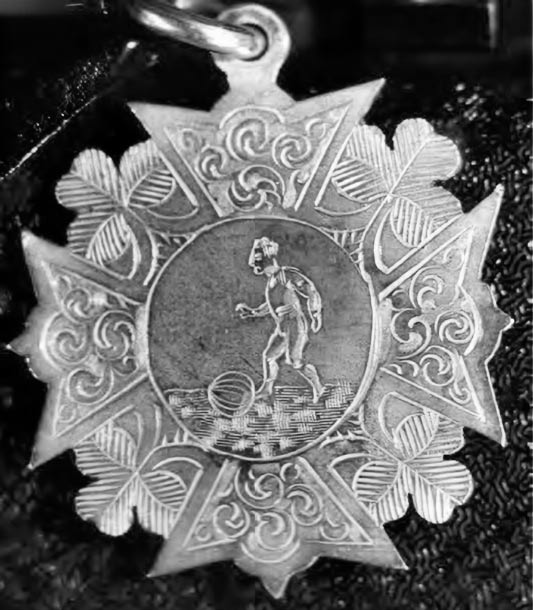
On Monday last a specially convened meeting of the Maryborough GAA was held for the purpose of presenting Mr. J. D. Gallagher with a silver star medal on his resignation as captain of the club, owing to his leaving the town.
The presentation was made on behalf of members by Mr. F. Harkham, secretary, who also read an address expressing regret at the loss which the Association felt at his departure from among them, and trusting that his future welfare should be one of continued happiness.
Other members having spoken, Mr. Gallagher replied at some length alluding in particular to the happy reflection he should always have of the Association of which he had the honour of being captain. He hoped that the club would continue in its flourishing condition and that nothing should be allowed to enter into their ranks which might cause dissatisfaction to any member.
After some further remarks in reference to the club, Mr. Gallagher bade the members farewell and said that he would always treasure the valuable medal he had received at their hands and which bore the following inscription:
“Presented to John D. Gallagher by the Juvenile Members of the Gaelic Athletic Association (of Maryborough) as a token of their Esteem for him as Captain – 1889”.
1889 honours
- Men’s Football – Senior Laois Senior Football Championship Maryborough 0-3 v 0-2 Wolfhill Captain: John Delaney
- Men’s Football – Senior Old Leinster Senior Club Football Championship Portlaoise 0-3 v 0-2 Newtown Blues