
Historical research is ongoing. This page was last updated on 18 August 2026 and will be expanded as further records, photographs and memories are contributed.
Decade Overview
New Challenges
The first decade of the twentieth century was a period of revival and renewed ambition for Maryborough GAA. While the opening years reflected the wider struggles of Gaelic games in Laois, interest in the club steadily increased through tournaments, growing participation and stronger representation in county affairs. The decade saw Maryborough players continue to contribute to county teams, the town host important GAA administrative meetings, and local figures such as Fr. J. J. Kearney emerge as influential leaders within the Association.
On the field, football fortunes improved significantly from the middle of the decade. Maryborough reached and contested senior championship finals, became embroiled in one of the most controversial championship disputes in county history, and were ultimately recognised as county champions for 1906. They followed this by securing a fifth Senior Football Championship title in 1907 and winning their first Junior Football Championship in 1908. The decade also witnessed the emergence of promising young talent, highlighted by success in the Minor Schools Football Championship in 1909.
Despite occasional setbacks, including disciplinary controversies and administrative disputes, the years from 1900 to 1909 laid important foundations for the club's future. By the end of the decade, Maryborough had re-established itself as a significant force in Laois football and was entering a new era with renewed confidence, stronger organisation and growing influence within Gaelic games across Leix and Ossory.
P. Ryan represents the club for Laois
In 1903, P. Ryan was the sole representative from Maryborough when Laois defeated Meath by 2-7 to 0-5 at Jones’ Road in the Leinster Senior Football Championship.
Pallas and the "Cherrypickers"
In August 1904, Knock met Pallas in a replayed first-round championship tie. Pallas emerged victorious on a scoreline of 1-6 to 0-5. Their team featured several well-known Maryborough footballers from previous years and included captain J. Kenny, P. Ryan, D. Coss, John and Paddy Crofton, Peter and Edward Duff, Joe and Jer Lalor among others.
Pallas were popularly known as the "Cherrypickers", a nickname which appears to have been inspired by the abundance of cherry trees in the locality.
Central Council Visits Maryborough
On Sunday, 20 August 1904, Maryborough hosted a meeting of the GAA's Central Council at Kelly's Hibernian Hotel. The meeting was chaired by Alderman James Nowlan, one of the most influential figures in the Association's early development.
J. J. Purcell represented Laois, while P. Bunworth attended as proxy for the Fermanagh delegate, highlighting Maryborough's importance as a venue for significant GAA administrative gatherings during the period.
Championship Winners Confirmed
At a subsequent meeting of the Laois County Committee, Abbeyleix were officially declared winners of the 1904 Senior Football Championship, while Kilcotton were confirmed as county hurling champions. The decisions were reported in The Nationalist on 11 March 1905.
Maryborough's championship campaign came to an early end in 1905, while important decisions taken at national level continued to shape the future direction and identity of the GAA.
Championship Defeat for Maryborough
On Sunday, 30 July 1905, Maryborough were defeated by Stradbally on a scoreline of 1-9 to 0-2 at Raheenabrogue in the Laois Senior Football Championship.
Stradbally proved far too strong on the day and went on to continue their championship campaign with a second-round victory over Abbeyleix before ultimately securing the county title.
Reporting on the game, The Nationalist of 5 August 1905 praised the winners' captain, J. Delaney, noting that "great credit is due to J. Delaney, the amiable captain of the victors who proved himself worthy of bringing victory to his team on such a large scale."
Important Decisions at GAA Congress
At the Annual National Convention of the GAA in early 1906, delegates debated and passed a number of significant motions which reflected the Association's efforts to strengthen its organisation and cultural identity.
Among the motions passed was a grant of £50 to Michael Cusack, the Association's first secretary, in recognition of the time, energy and personal expense he had invested in helping to establish the GAA on a lasting foundation.
Congress also reaffirmed the Association's commitment to maintaining a distinct identity by ruling that GAA competitions could not be held under the auspices of other athletic or cycling organisations. Another motion declared that athletes competing at events organised by the police, military or navy would be ineligible to take part in GAA sports meetings.
A proposal to remove the ban on members participating in Rugby and Association Football and allow county committees to decide the matter locally was heavily defeated by 51 votes to 15, demonstrating the strength of feeling within the Association regarding its cultural and sporting independence.
The year marked a major revival in Gaelic games in Maryborough. Tournament activity returned to the town, the footballers reached the county final, and a lengthy championship dispute ultimately led to the club being recognised as county champions.
Chairman: Father J.J. Kearney
Football Resurgent in the Town
Signs of an upsurge in activity were evident during the summer of 1906 when Maryborough organised a successful tournament. Clonaslee and Ballacolla contested a hurling fixture, Athy travelled to face the hosts in football, while Pallas took on Maryborough in a junior football game.
Around the same time, Maryborough recorded one of their most significant victories in years when they defeated highly-rated Stradbally by 0-7 to 0-1 in the championship semi-final. The game ended in controversy when referee R. Hipwell ordered a Stradbally player from the field. The player refused to leave and his captain refused to enforce the decision, leading the referee to award the match to Maryborough with two minutes remaining.
County Final Heartbreak
In preparation for the county final, Maryborough travelled to Offaly and defeated Tullamore by 1-6 to 0-3 in the Tullamore Tournament. Confidence was high heading into the county final against Raheenabrogue at Boley on 25 November 1906.
The final ended level, Maryborough scoring 0-8 while Raheenabrogue registered 1-5. Missing key players Bunworth and Bell through injury, Maryborough lined out with Joe Meehan (captain), Tom Meehan, Frank Meehan, Paddy Crofton, John Crofton, D. Mulready, Peter Duff, John Muldowney, P. Scully, F. Dowling, J. Brady, J. Bates, Richard Broomfield, John Kenny, J. Downey, P. Ryan and Richard Coss.
The replay was held at The Hollow on 16 December and Raheenabrogue emerged winners by 1-3 to 0-4. Maryborough immediately lodged an objection, claiming the referee had made a wager on the game and that the Raheenabrogue team had been illegally constituted.
Appeals and Controversy
The dispute dominated proceedings at a County Board meeting in Mountrath on 13 January 1907. Referee Jack Delaney of Stradbally denied making any bet and the committee upheld his report by sixteen votes to five. The second objection centred on whether Andrew Carroll had played for both Ballyroan juniors and Raheenabrogue seniors. Evidence was presented that the player involved was a different Andrew Carroll, and the County Board awarded the championship to Raheenabrogue.
Maryborough delegate Bunworth immediately appealed the decision to Leinster Council. While records of the council meetings no longer survive, later evidence strongly suggests the appeal was successful.
Champions of Queen's County
In August 1907, Maryborough were billed in newspaper reports as the champions of Queen's County when they faced Geashill, champions of King's County, at a major tournament in Clonaslee. Wearing their distinctive red and green colours, Maryborough defeated Geashill by five points to two.
Laois GAA historian Jack Hyland later confirmed that while some records continued to list Raheenabrogue as champions, the available evidence indicates that Maryborough were ultimately awarded the 1906 title. Further support for this view comes from a championship medal in Hyland's possession naming Maryborough as county champions for 1906.
A Championship Finally Secured
The long-running dispute was followed by further success on the field. On 28 July 1907, Raheenabrogue failed to fulfil a championship fixture against Maryborough and the game was awarded to the Town side. Although spectators were disappointed, the Maryborough Brass Band entertained the large attendance.
Maryborough continued their progress and on 17 November defeated Derrykearn by 1-7 to 0-1 at O'Moore's Forest after leading 0-4 to 0-1 at half-time. The delayed county final against Rathdowney was played in 1908, with Maryborough emerging victorious to secure what is widely recognised as the club's fourth Senior Football Championship title.
Leix & Ossory G.A.A. Notes
Clonaslee was a very lively spot on Sunday last as there was expected a great meeting of the clans at the local tournament. Three teams from Leix and Ossory were to meet three from Offaly, but the spirit of the notorious General Slum-battle, Ned Dunne, seemed to animate our friends beyond the Pass as they rather distinguished themselves by their absence.
However a gallant band, the Geashill football team, the champions of King's County for several years, crossed the frontier to try conclusions with Maryborough, the champions of Leix and Ossory. Mountrath and Rosenallis hurling teams in vain sought an enemy, and hence they crossed camans with each other.
Whilst the day was fine nothing was done, but when the rain appeared the play had to begin after 3 o'clock. Mountrath wore jerseys which looked well, and long trousers which might have belonged to their grandfathers, but which certainly were never intended for the hurling field. The Rosenallis men are nearly up-to-date.
The match was well contested, and at times some brilliant strokes were recorded. The Rosenallis camans were the more scientifically wielded, and secured the winning points. This team is of recent growth, it possesses some excellent hurlers and good all-round material for future events, and better still its members seem enthusiastic.
Without a moment's delay after the hurling match the Geashill and Maryborough football teams entered the field, and certainly they presented a pleasant sight, the green and white jerseys and white knickers of the former mingling with the red and green over white of the latter.
The game was rendered difficult by the ball being wet, but it was a grand exhibition of football from start to finish. It was an exceptionally fast match, each man fought for all he was worth, and no opportunity was lost. When the final whistle went Maryborough had won by five points to two, and so the gallant Geashills had met their Waterloo.
The ground arrangements were excellent. Outside the boundary line was a second line beyond which spectators were kept. Other clubs whose grounds are not roped or railed in might copy this idea, as people on or inside the line interfere considerably with the play.
1906 honours
- Men’s Football – Senior Laois Senior Football Championship Maryborough 0–8 0-4 (R) (obj) v 1–5 1-3 (R) Raheenabrogue Captain: John Delaney
Chairman: Father J.J. Kearney
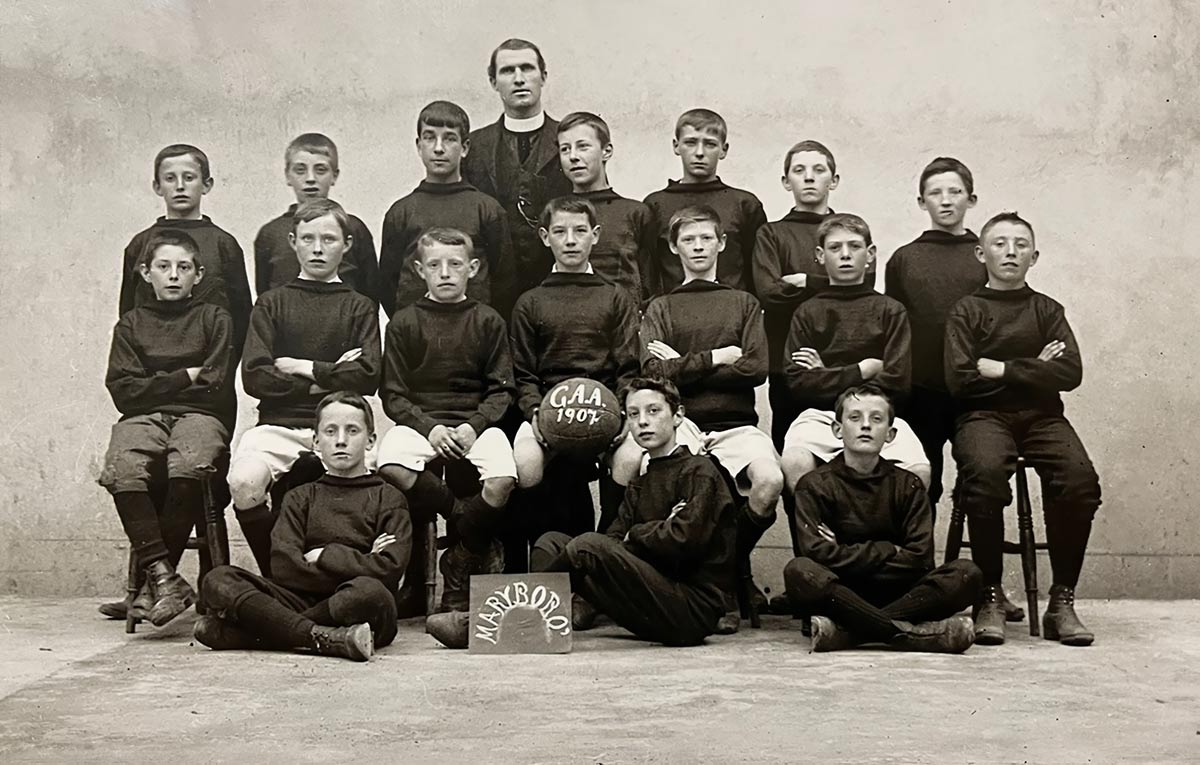
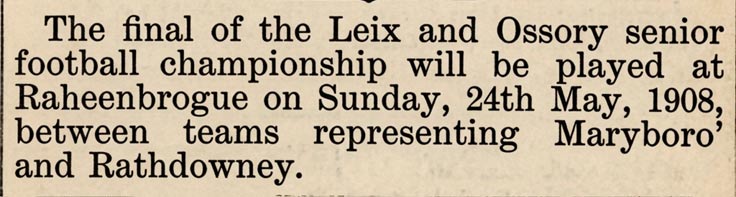
Fifth Senior Football Championship Title
Maryborough secured their fifth Senior Football Championship title in 1907.
The championship campaign included a scheduled fixture against Raheenabrogue on Sunday, 28 July 1907. A large crowd gathered for the game but were left disappointed when Raheenabrogue failed to appear. The match was subsequently awarded to Maryborough. Despite the absence of football action, those in attendance were entertained by the Maryborough Brass Band.
Maryborough's most notable performance of the year came on 17 November when they defeated Derrykearn by 1-7 to 0-1 at O'Moore's Forest. Having established a 0-4 to 0-1 advantage by half-time, they dominated the second period to record a convincing victory and advance towards championship honours.
The delayed county final was eventually played on May 25, 1908 against Rathdowne at Raheenbrogue with Maryborough emerging victorious to claim the 1907 championship. Unfortunately, neither the score nor a match report has survived. Contemporary evidence suggests that the team was very similar to the side that had contested the 1906 championship final.
The Maryborough panel of the period included captain Joe Meehan along with Tom Meehan, Frank Meehan, Paddy Crofton, John Crofton, D. Mulready, Peter Duff, John Muldowney, P. Scully, F. Dowling, J. Brady, J. Bates, Richard Broomfield, John Kenny, J. Downey, P. Ryan and Richard Coss.
Leix Senior Football Championship: Maryborough v Derrykearn
Maryborough met and beat Derrykearn in the senior football championship tie at O'More's Forest on Sunday last. The fact that the teams had already played a drawn game at Cremogue gave an added interest to this contest, and the result was a good assemblage of spectators.
It was well after the advertised time (Oh for the time when this phrase will cease to appear in our G.A.A. reports!) when the teams lined up before the referee, Mr A. McKeogh, Portarlington.
Derrykearn won the toss and put Maryborough to play against the hill. The latter drew first blood almost immediately after the start with a point. On delivery they pressed again, but Derrykearn, defending well, got into the centre of the field.
Maryborough, however, got back and notched two more points. Derrykearn braced themselves up and dashed to the other end, where their centre forward was fouled and off the free they scored their first and only point.
After some further play, Maryborough got back on the Derrykearn goal and scored another point. The whistle just went as they were notching another minor and so, at half-time, the score stood:
Maryborough 0-4
Derrykearn 0-1
The second half saw a better contested game and Derrykearn looked like scoring several times, but the Maryborough defence was too strong and they drove their opponents back on their own ground.
A foul by the Derrykearn custodian gave Maryborough a grand chance which they fully availed of, a goal resulting. This, with three minors, completed their second-half score and at the long whistle they stood victors with one goal and seven points to one point for Derrykearn.
Final Score: Maryborough 1-7, Derrykearn 0-1.
Mr. McKeogh gave universal satisfaction as referee.
1907 honours
- Men’s Football – Senior Laois Senior Football Championship Maryborough v Rathdowney Captain: Joe Meehan
Although Maryborough failed to retain the senior football championship in 1908, the club enjoyed success at junior level and continued to strengthen its playing ranks despite a number of administrative controversies during the year.
Chairman: Father J.J. Kearney
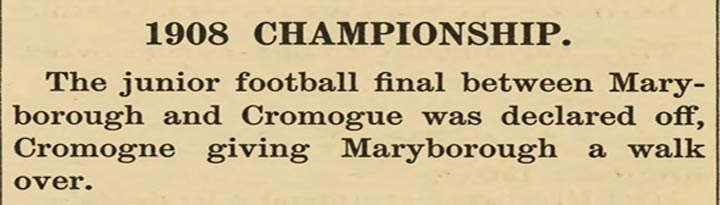
Maryborough win first Junior championship
In 1908, Maryborough captured the club’s first Junior ‘A’ Football Championship. The title was awarded after Cromogue conceded a walkover, giving Maryborough their breakthrough county success at junior level.
Field Dispute in Stradbally
Earlier in the championship campaign, Maryborough had been fixed to play Abbeyleix in Stradbally on 30 August. However, the owner of the field refused permission for the Maryborough team to play.
The matter was later discussed at a County Board meeting where Jack Delaney, captain of Stradbally, stated that his club had no involvement in the decision and bore no responsibility for the refusal.
Juvenile Team Disqualified
In September 1908, Maryborough's juvenile team was disqualified following an investigation into sports organised under GAA rules in the town.
According to reports in The Nationalist, military and former military personnel had been permitted to participate in the sports, while prizes had also been accepted from prison authorities. Both actions were deemed to be contrary to GAA regulations of the period, resulting in the team's disqualification.
Club Panels Published
In October 1908, The Nationalist published the playing panels for Maryborough ahead of championship fixtures against Abbeyleix in the senior competition and Ballybrittas in the junior grade.
The senior side was captained by Richard Booth and featured John Booth, Patrick Scully, Joseph Kenny, B. Bannon, T. Russell, J. Russell, T. Murray, L. Murray, J. Murray, M. Connor, J. Gray, P. Norton, W. Bergin, J. Brady, M. McEvoy, J. Crofton, J. O'Grady, A. Phelan, P. Guinan and Martin McEvoy.
The junior panel was captained by M. Donagher and included T. Kenna, P. Hargroves, P. Darrigan, A. Cushion, J. Dunphy, S. Dunne, J. McEvoy, J. Connell, J. Walsh, T. Keenan, W. McEvoy, J. Clery, M. Doody, D. Brady and M. Downey.
The publication of both squads highlighted the growing strength of football within the town and demonstrated the depth of playing resources available to Maryborough as the club continued its development in the opening decade of the twentieth century.
1908 honours
- Men’s Football – Junior Laois Junior ‘A’ Football Championship Portlaoise v Cromogue
While senior club success proved elusive, 1909 was a notable year for Maryborough through achievements at schools level and the continued influence of local figures in the administration of Gaelic games throughout Leix and Ossory.
Chairman: Father J.J. Kearney
Schools Championship Success
Maryborough claimed the Minor Schools Football Championship in 1909, providing an early indication of the football talent emerging in the town.
The Leix and Ossory Schools' League was overseen by Fr. J. J. Kearney as President, while Bob O'Keeffe, who would later serve as President of the GAA, acted as secretary. Following the final, Fr. Kearney presented the victorious Maryborough players with a set of winners' medals.
Strong Representation in County Affairs
Maryborough continued to play an active role in the administration of Gaelic games within the county. At the monthly meeting of the Leix and Ossory County Committee held in Mountrath on 29 March 1909, the town was represented by Kenny and Bunworth.
The meeting was chaired by Rev. W. Wilson C.C., with Fr. J. J. Kearney serving as vice-chairman. Fr. Kearney's influence within the Association continued to grow and at the 1909 County Convention he was re-elected vice-chairman.
Fr. Kearney and Bob O'Keeffe
The period also highlighted the growing prominence of two figures who would leave a lasting mark on the GAA. At the 1909 Convention, Ned Tarrant of Castletown narrowly defeated Bob O'Keeffe for the Ossory representative position on Leinster Council by 28 votes to 26.
By the time the County Convention met in Mountrath in April 1910, Fr. Kearney had assumed the role of county chairman and was returned to the position. On that occasion, Peter Daly defeated Bob O'Keeffe for the Ossory Leinster Council seat by 21 votes to 14.
Although Bob O'Keeffe was unsuccessful in both contests, he would go on to become one of the most influential administrators in the history of the Association, eventually serving as President of the GAA and later giving his name to the famous championship trophy contested in Leinster hurling.