
Historical research is ongoing. This page was last updated on 18 August 2026 and will be expanded as further records, photographs and memories are contributed.
Decade Overview
A Changing Ireland
The 1910s were a formative decade for Portlaoise, marked by strong leadership, growing organisation and continued involvement at the heart of Gaelic games in Laois. Fr. J. J. Kearney remained one of the most influential figures in county administration, serving as county chairman and guiding both the football and hurling clubs through a period of expansion and change. The decade saw regular club meetings, improved facilities, growing membership and ongoing debates around GAA rules, player eligibility and the future direction of the Association.
On the playing field, success was mixed but significant. Maryborough reached county finals in both football and hurling, captured the 1911 Junior Football Championship after defeating Portarlington twice, and won another Junior Football title in 1913. The club's hurlers also became increasingly competitive, running championship favourites Kilcotton close and regularly challenging the leading teams in the county. While senior honours proved elusive, the decade demonstrated the growing strength and resilience of Gaelic games in the town.
Beyond club activity, Portlaoise's influence extended across the county. Club administrators played prominent roles on county committees, while players and officials were regularly involved in major championship discussions and decisions. The town remained an important centre for both football and hurling administration throughout the period.
The defining moment of the decade came in 1915 when Portlaoise clubman and County Chairman Fr. J. J. Kearney helped oversee Laois hurling's greatest achievement. Led by a Ballygeehan-dominated team, Laois defeated Cork in Croke Park to win the county's first and only All-Ireland Senior Hurling Championship. The victory sparked celebrations across Laois and remains one of the most celebrated achievements in the county's sporting history. For Portlaoise, it represented the culmination of years of administrative leadership and commitment to the growth of Gaelic games in Laois.
The club entered a new decade with renewed energy, fresh leadership and growing participation. While success on the field proved mixed, Maryborough's administration was strengthened and the club remained at the centre of important debates about the future direction of the GAA.
Club AGM and New Committee
Officers elected at the club’s AGM held in April 1910 were:
President: Fr. Kearney; Vice-President: T. Cushion; Secretary: Joseph Foley (who replaced the retired John Higgins); Treasurer: Jas. Murphy; SH captain: Michael Collier; Vice-captain: P. Scully; SF captain: Richard Booth; Vice-captain: J. Russell; JH captain: Joe Fennelly; JF captain: J. Walsh; Committee: Collier, Donagher, Sammon, Kearney, Wallace, Moore, Croton, Casey, Guinan, McCormack, Murphy.
A resolution was passed expressing gratitude to Mr. George Vanston JPC, TC, “for the generous manner he always acted towards the club”. Club finances were in a satisfactory state “despite the considerable amount of money spent in providing a stand and other essentials”.
As we can see by the selection of the committee and the names of those present, the club has been inculcated with new blood. That augurs well for the success of hurling and its twin sport.
When a particular type of sport begins to cloy … there is nothing to arrest its decay recruiting in a wholesome way.
Over a year ago some of our footballers suddenly evinced a desire for Association (soccer) with the result that they put themselves out of the pale of gaeldom.
The new-fangled idea did not endure but still it had the effect of permanently withdrawing the services of some tolerably good players …
The report added:
There is no end or beginning to the Gaelic season, it seems to go on forever…. we have often advocated the necessity of having a closed season in Gaelic games as in practically all other types of sport …
When the thing goes on forever like Tennyson’s brook its one time partisans become satiated with it …
However the association are gradually correcting many anomalies but up to the present their movements in this direction have not been revolutionary.
There are many wrinkles which they could learn from a closer study of the rules governing kindred forms of football endeavour.
The latest change as to how the scoring should be done is a step in the right direction …
The old system had its drawbacks and did not encourage kicking the leather with precision …
More precise and deliberate kicking will go hand in hand with the new rules that govern scoring…
Then again with regard to the dismissal of players because they indulge in other outdoor games we have no hesitation in saying the views of the powers that be are rather straight laced and limited.
It will be only a matter of time till this rule, which is a primary one, will disappear along with some other anomalous ones.
Sport is not a religion that one phase of it should be practised to the exclusion of all others.
It is rather surprising when everything is considered why this rule, which shows a narrow spirit, has not been wiped off the rule book long ago.
The opinions of some of our Queen’s County Gaels would be interesting and we would be glad to print them.
Note the scribe’s reference to his belief that “it will be only a matter of time” before the rule that outlawed other outdoor games, later popularly known as foreign games, would be rescinded. The rule was not removed until 1971.
On the Field
The club qualified for the Junior Hurling Championship Final of 1910 by beating Ballacolla at Raheen by 6-1 to 4-0. This victory sent them through to meet either Raheen or Errill in the county final.
The senior footballers reached the county final but were defeated by Stradbally at Abbeyleix on a scoreline of 2-3 to 0-3.
President: Father J.J. Kearney; Vice-President: Father Bermingham and Thomas Cushion
Disputes on and off the Field
A split in the hurling club was discussed at a County Board meeting in May 1911. Around the same time, controversy arose regarding the eligibility of a Ratheniska player in a championship fixture against Portarlington.
Dear Sir, In last week's issue a report of the above committee appeared in which an objection by Portarlington against Ratheniska being awarded the match played at Vicarstown on 30 April came up for hearing.
The objection was that Joseph Campion, a Ratheniska player, was a reserve soldier. After a little discussion the consideration of the objection was adjourned to next meeting for "proof".
Now sir, I would like to know what proof those gentlemen require. Every man in Maryborough connected with the GAA is well aware that Joseph Campion, New Road, Maryborough, is a reserve soldier who wouldn't be allowed to play for Maryborough.
From enquiries made at the Post Office, Maryborough, I find that Campion is drawing his pension through that office. I believe Ratheniska are denying that he was a reserve man. Then why not produce his discharge, as they cannot deny he was a soldier and not put Portarlington to the trouble and expense of proving it.
The letter appeared in The Nationalist of 20 May 1911 and reflected the continuing tensions surrounding player eligibility and the enforcement of GAA regulations.
County Final Venue Dispute
Stradbally were fixed to play Maryborough in the Senior Football Championship Final on 13 August 1911. The selection of Abbeyleix as the venue was carried by a majority of one vote at County Board level.
County Chairman Fr. Kearney argued that Maryborough was the most suitable venue for the final and that it also made the most sense financially. His proposal was seconded by Stradbally captain Jack Delaney, meaning that both competing clubs had agreed on Maryborough as the venue.
The matter did not rest there. E. McEvoy of Abbeyleix complained that the town seldom received tournament games and successfully proposed Abbeyleix as the venue.
After the result the chairman then declared that Maryborough would not go to Abbeyleix so he said he supposed it would be a walkover for Stradbally.
Mr. McEvoy said that Abbeyleix never refused to go to Maryborough.
The chairman replied: "I have no personal objection to Abbeyleix. It is on principle that I object."
The final eventually took place in Abbeyleix on 27 August 1911, with Stradbally emerging victorious by 2-3 to 1-2. Pat Dunphy acted as referee.
At a later discussion on the final, Fr. Kearney pointed to the financial consequences of the venue decision.
Receipts were £6 and expenses were £9 odd and the medals had to be paid for as well.
"That was thanks to some of the gentlemen who voted to have it in Abbeyleix."
Boley's Objection Rejected
Another dispute came before the County Board when Boley objected to Wolfhill's Division 2 victory by 2-0 to 1-2.
The objections were that the Wolfhill goalkeeper was not properly dressed, that Wolfhill supporters had entered the playing area and interfered with play, and that Wolfhill had fielded an illegal player, Peter Brennan.
Fr. Kearney rejected the objection, ruling that the breaches complained of were technical in nature and insufficient to overturn the result. The decision was reported in The Nationalist on 13 January 1912.
Junior Football Championship Success
Maryborough captured the Junior Football Championship in 1911 (played at Vicarstown on Sunday, February 23, 1912) after overcoming Portarlington in a final that had to be played twice following an objection.
The original final took place at Vicarstown on Sunday, 23 February 1912. Maryborough emerged victorious by 1-2 to 1-0, securing what appeared to be a hard-earned championship success.
Portarlington subsequently lodged an objection to the result. However, before the matter could proceed further, the objection was withdrawn and the final was ordered to be replayed.
When the sides met again on 9 October 1912, Maryborough once more proved the stronger team. On this occasion they recorded a convincing 2-1 to 0-2 victory, removing any doubt about the destination of the title.
1911 honours
- Men’s Football – Junior Laois Junior ‘A’ Football Championship Portlaoise 1-2 v 1-0 Portarlington Captain: John Delaney
Chairperson (Young Irelands Hurling Club): Father J.J. Kearney
County Officers Re-Elected for 1912
Fr. Kearney was re-elected Chairman of the County Committee for 1912. Mr. Miller was re-elected as trustee.
Young Ireland Hurling Club Expansion Plans
The Maryborough Young Ireland Hurling Club held their adjourned AGM on Monday, 10 March, 1912 on their own grounds. The main purpose of the meeting was to double the number of teams to be entered in the championships.
The Nationalist, 20 March 1912.
Championship Setbacks and Player Reinstatements
Stradbally beat Maryborough 4-1 to 0-0 in the Senior Football Championship on 11 August 1912 and went on to defeat Portarlington by 1-1 to 0-2 in the final.
Portarlington lodged an objection. One of the grounds cited was that James Gray and John Whelan had taken part for money prizes at a sports meeting in Ballybrittas which was not governed by GAA laws.
The Chairman deemed the charge proven and awarded the game to Portarlington (Nationalist, 9 November 1912). However, the decision may subsequently have been overturned, as Stradbally is listed as the Senior Football Championship winners for that year.
Two Maryborough players, Joseph Delaney and Frank Meehan, were reinstated by the county committee in August 1912.
In September, the senior hurlers drew with Rathdowney in the championship semi-final, but Rathdowney won the replay and later defeated Kilcotton in the final.
Maryborough Hurling Club AGM Held in CYMS Rooms
The AGM of the Maryborough Hurling Club was held in the CYMS rooms on Sunday, 2 March 1913, with M. P. Collier, RDC, and subsequently Fr. Kearney, presiding.
Those present included J. Fitzpatrick (Hon. Sec.), J. Bergin, L. Brady, P. Kavanagh, J. Higgins, M. Farrell, P. Lanihan, M. Cribbs, Owen Cribbs, B. Watson, M. Bergin, T. Moore, T. Brady, O. Moran, T. Higgins, J. Foley (Hon. Treas.), F. Bergin, J. Walsh, J. Kehoe and J. Walsh.
The secretary was glad to be able to state that although membership had fallen during the previous year, the club remained in a healthy financial position.
“We are quite clear financially.”
The balance sheet showed £5 6s 6½d cash in hand and £5 6s 6d in disbursements.
“We came out with cash in hands – of a halfpenny,” said the secretary. (Laughter).
Mr. Collier replied: “It is better than coming out in debt.”
The club played nine games during the previous year, winning four, losing three and drawing two.
“Our best effort was drawing with the champions, Rathdowney, (in the SHC semi-final) and with a little luck we might have reached the final.”
Fr. Kearney recalled attending that match and praised the standard of hurling on display.
“What was better than medals, gold or silver, was the good reputation they had won. The conduct of the players in practice and matches was most exemplary. It is a pleasure for me to be associated with the club.”
He went on to speak about the benefits of young people joining clubs such as Maryborough, where they could learn sportsmanship, self-control and temperance.
Officers elected:
President: Fr. Kearney
Vice-Presidents: Fr. Bermingham and Thomas Cushion
Captain: Lar Brady
Vice-Captain: M. P. Collier
Secretary: J. Fitzpatrick (re-elected)
Treasurer: J. Foley (re-elected)
Committee: J. Cripps, O. Moran and J. Bergin, together with the club officers.
It was decided to enter both senior and junior teams in the forthcoming championships.
The Nationalist, 8 March 1913.
Junior Football Championship Success
Maryborough captured the Junior Football Championship title by defeating Ratheniska 2-4 to 1-3 at Ballybrittas in March 1913.
Maryborough held a commanding 2-4 to 0-2 lead at half-time, but Ratheniska mounted a strong second-half comeback. However, poor shooting proved costly and they were unable to bridge the gap.
Jack Delaney of Stradbally was the referee.
Brave Hurling Display Against Kilcotton
In the first round of the Senior Hurling Championship, the county town side put up a spirited performance against the high-flying Kilcotton team, who were the dominant force in Laois hurling during this period.
Having won the toss, Kilcotton played with the benefit of a strong breeze at Rathdowney and built up a 3-2 to 0-0 lead by half-time.
Maryborough took control after the break and scored 4-1 to move into the lead. However, Kilcotton were awarded a goal which was hotly disputed. Referee Peter Daly allowed the score to stand and gave Kilcotton the verdict.
Led by the legendary Jack Carroll, who would later achieve All-Ireland success in 1914 and 1915, Kilcotton went on to capture the championship title.
Rathdowney End Football Championship Hopes
Rathdowney brought Maryborough's Senior Football Championship campaign to an end in 1913, defeating them by 2-3 to 0-2 at Abbeyleix.
Maryborough Football Club Reorganised
A meeting was held in January 1914 for the purpose of reorganising Maryborough Football Club and preparing for the coming season.
President: Fr. Kearney
Vice-Presidents: Fr. Bermingham, Thomas Cushion and John Bunworth
Captain: Joe Meehan
Vice-Captain: J. Conlon
Secretary: J. Bunworth
Treasurer: J. Higgins
Selection Committee: The club officers together with Michael McEvoy and J.
Delaney. Committee (elected by ballot): F. Meehan, J. Delany, John O’Neill,
Michael
McEvoy, J. McEvoy, J. Kelly, H. Dunphy, J. Dunphy and T. Territt.
Hurling Club Prepares for 1914 Season
Maryborough Hurling Club held its AGM in February 1914 and elected the following officers for the year ahead.
President: Fr. Kearney; Vice-Presidents: Fr. M. Byrne, Fr. T. Bermingham and Thomas Cushion; Secretary: J. Fitzpatrick; Treasurer: James Foley; Committee: Thomas Brady, Owen Moran, James Cribbs, M. P. Collier, RDC, and J. Bergin; Senior Captain: Thomas Dunne; Senior Vice-Captain: Lar Brady; Junior Captain: P. Lanham; Delegate to County Board: M. P. Collier; Delegates to County Convention: M. P. Collier and Lar Brady;
It was decided to enter both senior and junior teams in the forthcoming championships.
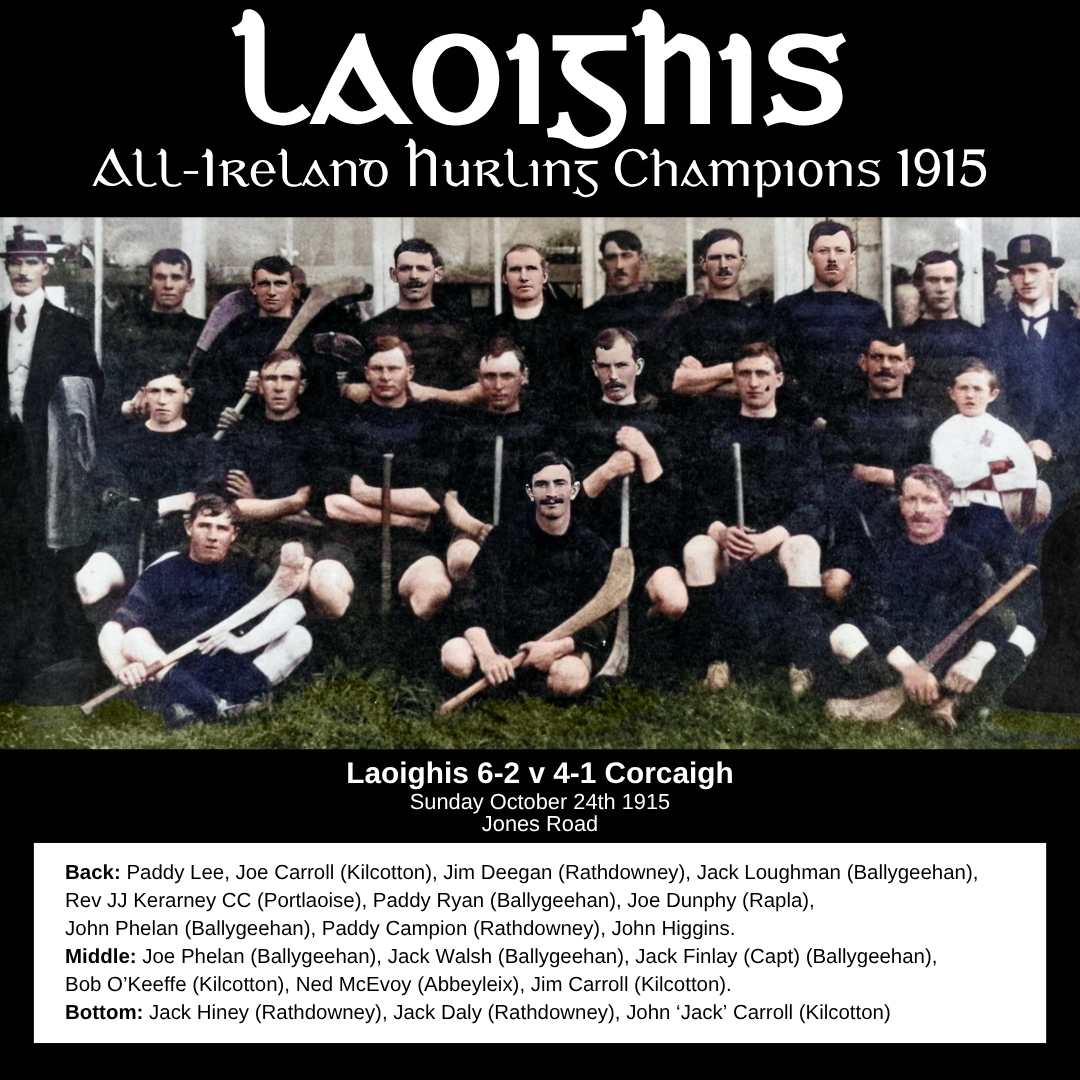
Fr Kearney and Laois hurling
In 1915, Portlaoise clubman and Laois County Chairman Fr. J. J. Kearney played a key role in one of the greatest achievements in the county's sporting history as Laois captured its first and only All-Ireland Senior Hurling Championship.
Represented primarily by the Ballygeehan club, the Laois team travelled by train to Dublin on 23 October for the final against hot favourites Cork. The following morning they attended Mass before making the walk from their Gardiner Street hotel to Jones' Road carrying their hurleys, dressed in the black and amber hoops worn by Laois at the time.
Interest in the decider was enormous, with seventeen special trains bringing supporters from around the country to Dublin. Despite heavy rain and difficult conditions, a crowd of around 12,000 gathered in Croke Park to witness the final.
Cork made the stronger start and struck three early goals, but Laois battled back through scores from Joe Phelan, John Phelan and Tom Finlay to trail by just a point at half-time. Before the throw-in, Laois officials had coated their hurleys with resin to improve grip in the wet conditions, a decision that would prove significant as the game wore on.
Laois dominated the second half. Jack Hiney scored three goals, while Jack Carroll and Joe Hiney also found the net as the underdogs overwhelmed Cork. When referee William Walsh of Waterford sounded the final whistle, Laois were All-Ireland champions on a scoreline of 6-2 to 4-1.
Celebrations swept across the county as the victorious team returned home. Bonfires lit the hillsides and huge crowds gathered to welcome the players, led by captain Jack Finlay, as they paraded through Abbeyleix behind a pipe band. More than a century later, the triumph remains the only All-Ireland Senior Hurling title ever won by Laois and stands as one of the county's greatest sporting achievements.
The Laois squad was,
Joe Carroll (Kilcotton), Jim Deegan (Rathdowney), Jack Loughman (Ballygeehan), Paddy Ryan (Ballygeehan), Joe Dunphy (Rapla), John Phelan (Ballygeehan), Paddy Campion (Rathdowney), Joe Phelan (Ballygeehan), Jack Walsh (Ballygeehan), Jack Finlay (Capt) (Ballygeehan), Bob O’Keeffe (Kilcotton), Ned McEvoy (Abbeyleix), Jim Carroll (Kilcotton), Jack Hiney (Rathdowney), Jack Daly (Rathdowney), John ‘Jack’ Carroll (Kilcotton)