
Historical research is ongoing. This page was last updated on 18 August 2026 and will be expanded as further records, photographs and memories are contributed.
Decade Overview
A Decade of Renewal
The 1920s proved to be one of the most significant decades in the early history of Portlaoise GAA. Emerging from the upheaval of the War of Independence and Civil War, the club experienced a revival in both hurling and football, while Gaelic games became increasingly embedded in the life of the town.
The decade saw the gradual transition from Maryborough to Portlaoighise and eventually Portlaoise, reflecting the wider cultural and political changes taking place across Ireland. New clubs and teams emerged within the town, including Green Road and IRA Signals, while local volunteers, administrators and players helped strengthen the organisation of Gaelic games throughout the county.
Success arrived at underage level in 1923 when Portlaoise captured its first Minor Hurling Championship, producing players such as Matt Walsh who would go on to become one of the most influential figures in club history. Green Road added Junior Football Championship honours in 1924, while the club continued to field competitive teams across multiple grades.
Throughout the decade, Portlaoise remained closely involved in county affairs through figures such as Nicholas Fortune, Sean Barrett, Fr. Monaghan and many others who served on committees and represented the club at County Board level. The period also saw memorable challenge matches, visits from leading teams, and growing public interest in Gaelic games across the town.
The defining moment arrived in 1928. After years of steady progress, Portlaoise captured its first ever Laois Senior Hurling Championship, defeating Clonad in a dramatic final at O'Moore Park. Led by captain John Dunne and inspired by players such as Jimmy Fortune, Paddy Doran, Ger Kelly, Lar Cushion and Mick Dunne, the victory established Portlaoise among the leading clubs in the county and remains one of the landmark achievements in the club's history.
Hurling Revival and a New Name for the Town
Hurling activity in the town enjoyed a revival during the early 1920s. In June 1921, Maryborough defeated Clonaslee by 5-2 to 4-0 in the Junior Hurling Championship, one of the club's most notable victories of the period.
Later that year, a hurling match formed part of the Aeridheacht celebrations held at the Gaelic Grounds during the visit of Countess Markievicz to the town. A Portlaoighise selection defeated Camross by 3-1 to 2-2, with Nicholas Fortune acting as referee.
The occasion is significant as it appears to be the first recorded use of the Irish name Portlaoighise in place of Maryborough in connection with the club and local Gaelic games.
Delayed Senior Football Final
The 1921 Senior Football Championship Final was not played until the following year. When the final was initially fixed for March 1922, The Heath arrived late while Annanough failed to appear.
Spectators who had already paid admission demanded refunds when it became apparent that no game would take place. An ugly scene was only avoided through the intervention of Sean Barrett of The Oak, Mr. Carew of Mountmellick and Nicholas Fortune of Portlaoighise.
The final was subsequently re-fixed for 23 April 1922.
Chairperson: Nicholas Fortune
Senior Hurling Final Appearance
Portlaoise reached the 1922 Senior Hurling Championship Final, although the decider was not played until 1923. Rathdowney proved too strong on the day, winning by 4-3 to 2-1.
The Portlaoise team was:
Kirwan, Mick Dunne, Jim Fortune, Donovan, Lar Cushion, Tommy Whelan, Jack Connell, Tim Muldowney, Paddy Dunne, J. Connell, Mick Conroy, Billy Carroll, Jack Dunne and Mick McLoughlin.
The final was refereed by Bob O'Keeffe of Kilcotton, a member of the famous Laois All-Ireland winning team of 1915 who would later serve as President of the GAA.
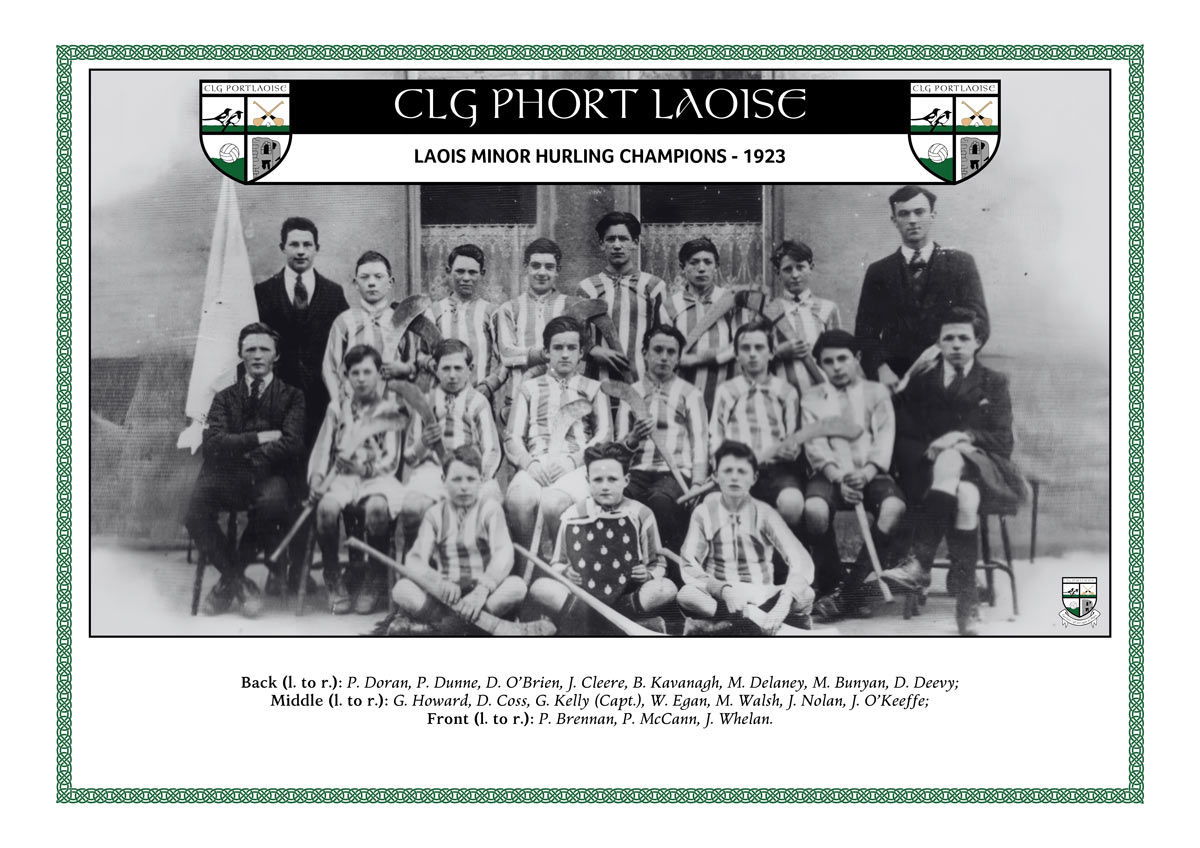
Minor Hurling Champions
Portlaoise enjoyed success at underage level in 1923 when they captured the Minor Hurling Championship.
Among the players on the winning team was Matt Walsh, later Fr. Matt Walsh, who would become one of the most influential figures in the club's history. He served as Life President of Portlaoise GAA from the early 1950s until his death in 1995 and remains one of the most respected names associated with the club.
New Clubs Affiliated in Portlaoighise
The growing popularity of Gaelic games in the town was reflected in the list of club affiliations for 1923. Among those affiliated to the County Board were IRA Signals, Portlaoighise and Green Road, Portlaoighise, illustrating the emergence of new teams and organisations within the town during the period.
Their inclusion highlights the broadening reach of the GAA in Portlaoise and the strong community support for Gaelic games in the years following Irish independence.
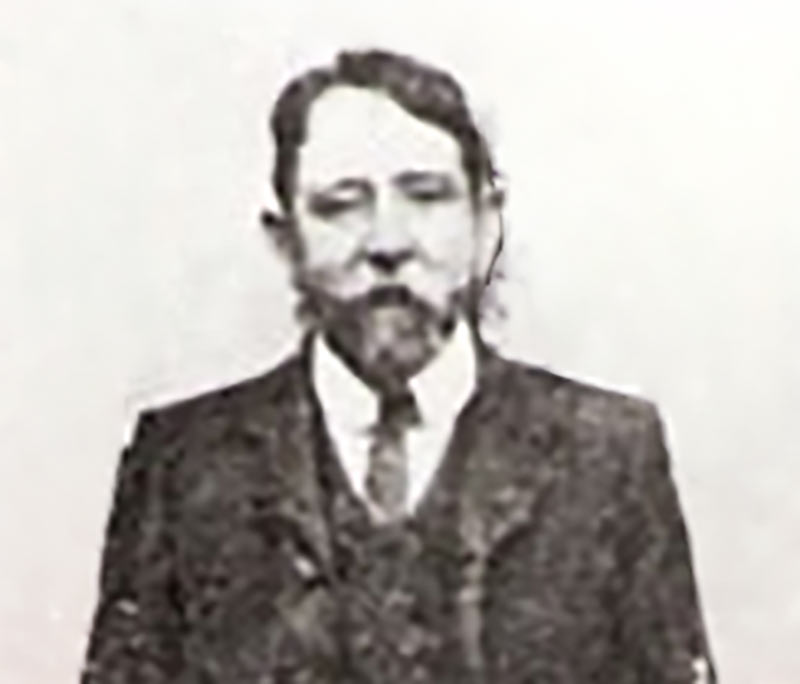
Dr Thomas F. O’Higgins murdered
Dr Thomas F. O’Higgins played a central role in the foundation of Portlaoise GAA Club when he chaired the inaugural public meeting held in the Town Hall, Maryborough, on Monday 28 November 1887. At the meeting, Dr O’Higgins strongly supported the establishment of a Gaelic Athletic Association club in the town and described it as “a very desirable movement”, urging the people of Maryborough to support the growth of Gaelic games locally.
A popular general practitioner based in Stradbally, Dr O’Higgins was widely respected throughout Laois. He married Anne O’Sullivan, daughter of T.D. O’Sullivan, who had previously served as Lord Mayor of Dublin. Through both his professional and public life, Dr O’Higgins became closely associated with Irish national and cultural life during a hugely significant period in Irish history.
Tragedy would later strike the family during the turbulent years surrounding the Civil War. Dr O’Higgins was murdered at his home outside Stradbally in 1923. His son, Kevin O’Higgins then Minister for Home Affairs, became one of the most important political figures in the early Irish Free State and played a leading role in establishing the institutions of the new state, including the formation of the unarmed Garda Síochána.
Kevin O’Higgins adopted a hardline position during the Civil War and, as a result, attracted fierce opposition from republican opponents. In July 1927, he was assassinated while walking to Mass on Booterstown Avenue in Dublin.
1923 honours
- Hurling – Junior Laois Junior ‘A’ Hurling Championship
- Hurling – Minor Laois Minor ‘A’ Hurling Championship
Chairperson: Father W. Monahan
Green Road Claims Delayed Junior Football Title
Gaelic games continued to flourish in Portlaoighise during 1924. Early in the year, Clonad and Portlaoise met in a minor hurling fixture, while on 13 April Green Road, Portlaoighise finally captured the long-awaited 1922 Junior Football Championship title.
Green Road defeated The Swan by 3-4 to 1-2, with Cushion delivering an outstanding performance. Delaney, Mick Dunne and Kealy also impressed, while Jack Dunne provided strong leadership from the forward line.
Senior Hurlers Impress
In May 1924, Portlaoighise recorded an impressive 7-3 to 5-0 victory over Camross in the Senior Hurling Championship. Among those who featured prominently were Jack Dunne, Lar Cushion, Jimmy Fortune, Mockler and Tommy Whelan.
The game was notable for the large number of broken hurleys, which were becoming increasingly difficult to replace.
Club Reorganisation
A joint meeting of the football and hurling clubs took place in August 1924. Secretary Mr. Kealy tendered his resignation and at a subsequent meeting in the CYMS Hall on 14 August, Sean Barrett was elected as his successor.
Kealy subsequently accepted the role of vice-chairman pending the availability of Fr. Monaghan, who was expected to take over as chairman.
John Dunne was appointed senior hurling captain with his brother Mick serving as vice-captain. W. Kealy became football captain with Lar Cushion as vice-captain, while Brennan and Doran were elected captain and vice-captain respectively of the junior team.
Sean Barrett and Martin Delaney were appointed as the club's delegates to the County Board.
Junior and Senior Hurling Activity
The junior hurlers travelled to Clonad on 14 September 1924 to face Trumera. The team lined out as follows:
J. McEvoy (goal), E. Brennan (captain), M. Hyland, J. Kelly, B. Quinlan, J. Conroy, P. Doran, P. Dunne, E. Moy, P. Lanham, W. Delaney, W. Morrissey, W. Keogh, T. Keogh, P. Brennan. Subs: A. Loughlin, J. McEvoy, C. McAulliffe, J. Dargan.
On the same day, the senior hurlers defeated Durrow by 3-6 to 4-2 in a medal challenge match.
J. Larkin (goal), J. Donovan, Joe Whelan, J. McLoughlin, T. Muldowney, M. Conroy, W. Hogan, J. Connell, T. Whelan, M. Dunne, W. Kealy, Lar Cushion, W. Carroll, J. Fortune, J. Dunne (captain).
The teams were led onto the field by the Portlaoighise Pipers Band, adding a festive atmosphere to the occasion.
Recognition for Sean Donovan
On Christmas Eve 1924, Sean Donovan was honoured for his contribution to the club when he received an engraved cigarette case from Messrs. Hogan, Irwin and Kearns in recognition of services rendered to the Portlaoighise club.
All-Ireland Champions Visit Portlaoighise
The year began with a prestigious challenge match when reigning All-Ireland champions Kickhams visited Portlaoighise on 25 January 1925. In an exciting contest, the visitors emerged victorious by 2-1 to 1-3.
Outstanding performers for Portlaoighise included Jimmy Fortune in goal, Lar Cushion, Mick Dunne, P. Kelly, John Dunne, S. Donovan, Kirwan, Campion, Jack Dunne and Whelan.
Championship and Challenge Matches
On 26 April 1925, Clonad defeated Portlaoighise by 0-12 to 0-2 in a Senior Hurling Championship fixture played in the demesne of Mr. D. Kennedy at Abbeyleix.
The following month, the Green Road junior team faced Clonreher in a challenge match played on a field kindly provided by Mr. J. P. Bannon.
The teams were led onto the field by the Harpur's Lane Fife and Drum Band under the conductorship of Mr. Thomas Porter. Green Road proved far too strong for their opponents, recording a convincing 3-1 to 0-0 victory.
Football Championship Progress
The Town side enjoyed success in the Senior Football Championship, defeating Kellyville to reach the semi-final stage of the competition in late May 1925.
Ultimately, defending champions Annanough retained their title, defeating Ballyroan by 4-2 to 0-5 in the county final played on 18 October 1925.
Championship Action and New County Colours
Portlaoise enjoyed a busy year across both football and hurling competitions in 1927. The junior hurlers opened the year with a 3-1 to 2-1 victory over Clonkeen on 9 January, a result which qualified them to face either Mountrath or The Pike of Rushall in the next round of the championship.
The junior footballers were less fortunate. In a replay at Killenard on 13 March, Mountmellick defeated the Town by 2-4 to 1-2.
Portlaoighise: M. Conroy, W. Carroll, Jimmy Fortune, J. Dargan, Lar Cushion, Sean Pleamonn, T. Whelan, S. Fennell, Ger Kelly, Joe Fennelly, W. Delaney, Paddy Doran, H. King, J. Dunne and E. Brennan.
Strong Performances in Hurling and Football
On 3 April 1927, Clonad edged Portlaoighise by a single point in an exciting league encounter. Lar Brady excelled at full-back for Clonad, while Portlaoighise's leading performers included John Dunne at full-back, Fint Conroy at midfield and forwards Ger Kelly and "Butcher" Dunne.
The senior hurlers enjoyed better fortunes later in the year, defeating Mountmellick by 3-4 to 1-2 at Ballytegan on 23 August. Michael Collier officiated as referee.
In the Junior Football Championship, however, Portlaoighise were eliminated by Loughteague, who won by 2-5 to 1-0 at Pallas on 27 November. The match was refereed by M. Delaney of Pallas.
Success for CBS and a New Look for Laois
While county honours eluded Portlaoise teams, there was local success when Portlaoighise CBS captured the Under 16 Hurling Championship.
Elsewhere, Abbeyleix won the 1927 Senior Hurling Championship by defeating Rathdowney 6-3 to 3-2, while Graiguecullen secured the Senior Football Championship title with a 1-5 to 0-1 victory over Stradbally.
The year also marked the end of an era for Laois teams. Up to 1927, county sides wore the traditional black and amber hooped jerseys associated with the county's famous 1915 All-Ireland-winning hurlers.
"In future teams will wear Royal Blue jerseys having a band of white on the body and arms. It is hoped that a change of colours will bring a change of fortune ..."
The announcement, reported in The Nationalist on 8 May 1928, marked the beginning of the blue-and-white colours that would become synonymous with Laois teams in the decades that followed.
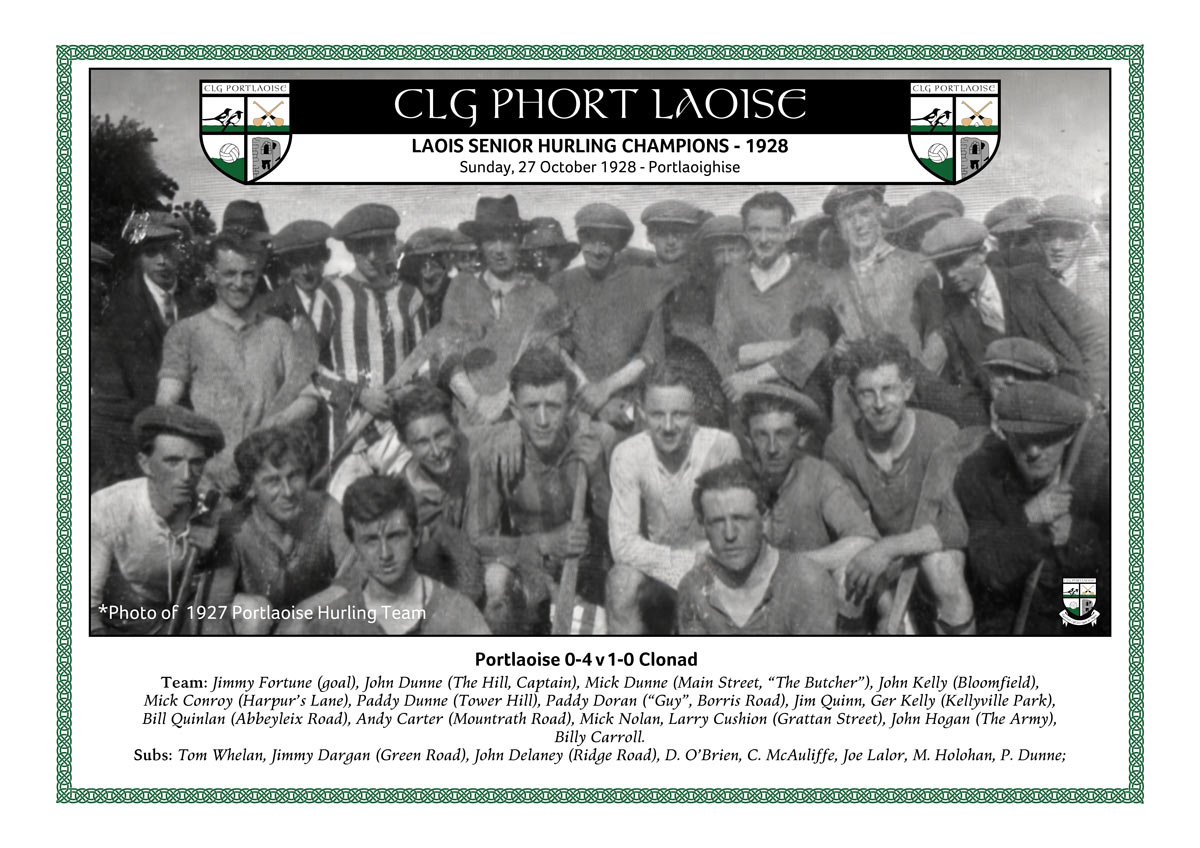
Portlaoighise Win First Senior Hurling Title
Indications of events to come were shown when Portlaoighise and Ballacolla drew 3-3 apiece at Clonad in the championship of 1928.
John Dunne (captain), Jimmy Fortune (goalie), Mick Dunne, Ger Kelly, Mick Conroy, Paddy Dunne, Paddy Doran, Bill Quinlan, Lar Cushion, Andy Carter, Jimmy Dargan, William Carroll, Mick Nolan, Jim Quinn, M. Holohan.
This was a promising display by the "Town" hurlers. Portlaoise won the replay at Abbeyleix but Ballacolla objected on the grounds that Andy Carter being a member of the Hollow team was ineligible to play for Portlaoighise.
Mr. Barrett (Portlaoighise) told the County Board meeting that the objection should not be considered as it did not comply with the Irish language rule. The Chairman, Lar Brady, read the rule and decided the objection was out of order.
Having got over this hurdle, Portlaoighise moved on to the semi-final in which they beat Rathdowney by 9-3 to 3-1.
Road to the Final
The Nationalist preview of the game told of the impressive progress of both teams to the final clash which whipped up huge interest especially in the town and surrounding areas.
Having detailed Portlaoise's path through the championship, the report told of the equally impressive run of Clonad despite being weakened by emigration.
On 27 May, they beat the "ex-juniors", Camross by 6 goals to 3 and then shocked Abbeyleix in the semi-final by 3-1 to 1-2 in what was categorised as:
"Surely the surprise of the year".
This set up a final between two great neighbouring rivals, both of whom were contesting the final for the first time.
The sides had already met in a Feis Medal match which the "Town" won fairly comfortably.
Clonad were expected to field a stronger team with Billy Morrissey and Ned Parkinson available again and it was predicted that "it will be a game worthy of the best traditions of the Gael … no matter which side wins we are promised a great game where no quarter will be given or asked for …"
The revered Laois Gael and former hurling star, Pete Daly of Rathdowney, was referee.
The Final at O'Moore Park
In the report on the final played at O'Moore Park on 26 October 1928, it stated:
"The general opinion was that, granted a fine day with quick going the lighter and faster Portlaoighise team would win ... but those of that opinion reckoned without Clonad".
In a game played in a very sporting manner:
"No mean tactics were introduced by either side from start to finish".
Both defences were well on top and:
"The attacking forces were well subdued."
Lar Brady and his fellow backs prevented the opposing forwards from getting through and the pity was that Portlaoighise did not "open" the game more and swing the ball from wing to wing.
On the other side Jack Dunne and his co-workers were equally good with the youthful Mick Dunne ever in the picture.
Jack Conroy and Paddy Fitzgibbons did best in the half-back line for the vanquished while the victors were also ably served by Mick Conroy, Paddy Dunne and Paddy Doran.
"The latter was outstanding even if he did not reach the heights of his performance against Rathdowney."
Ger Kelly and Bill Quinlan were also prominent for the winners.
"Doran got a bad knock in the second half when he came in collision with a sideline seat. Happily no bones were broken and he had the satisfaction of scoring the winning point."
Both goalkeepers, Bergin and Fortune, did what was required of them.
"Special praise is due to Messrs. Farrell and McEvoy who acted as trainers to the Portlaoise team for a fortnight previous to the game. By the way whoever got the Clonad team into form is also worthy of congratulations."
Match Report
"It was seen that Dargan was off the 'town team' owing to an injury. Portlaoighise were playing into the town goal but Clonad were first to move forward … Ger Kelly put his forwards in possession but Lar Brady was not to be caught napping … Mick Nolan helped Lar Cushion to get the opening point after 12 minutes play …"
Then came a Clonad burst and forced a free fifty yards out.
"Sean Conroy was entrusted with the puck. He placed well in the goalmouth and Fortune was beaten by either Tom Brady or W. Morrissey for a goal after 23 minutes play."
This left Clonad in the lead by 1-0 to 0-1 at the interval.
On the restart Ger Kelly shot a point for Portlaoighise and then crashed home a goal but:
"To the dismay of the team and followers."
The score was disallowed owing to a square infringement.
Around the three-quarter stage Andy Carter shot over the equaliser and just when visions of a drawn game became apparent, Carter forced a "70".
"A lot depended on Paddy's aim. Would he score? Advice was freely given. He lifts, and the ball sails over for the winning point."
Clonad still refused to surrender.
"Still Clonad are not beaten! They fight back and John Dunne was busy clearing. Costigan and Fitzgibbons try to open up the play and Fortune was just in time to beat the Clonad forwards, while a moment later, Mick Dunne ('Butcher') clears when the situation is dangerous …"
And so the Town survived to win their first senior hurling title. The club would not win another for fifteen years and would not register a third success until 1981, fifty-three years later.
Portlaoighise: Jimmy Fortune (goal), John Dunne (The Hill, Captain), Mick Dunne (Main Street, "The Butcher"), John Kelly (Bloomfield), Mick Conroy (Harpur's Lane), Paddy Dunne (Tower Hill), Paddy Doran ("Guy", Borris Road), Jim Quinn, Ger Kelly (Kellyville Park), Bill Quinlan (Abbeyleix Road), Andy Carter (Mountrath Road), Mick Nolan, Larry Cushion (Grattan Street), John Hogan (The Army), Billy Carroll. Subs: Tom Whelan, Jimmy Dargan (Green Road), John Delaney (Ridge Road), D. O'Brien, C. McAuliffe, Joe Lalor, M. Holohan, P. Dunne.
Clonad: Ned Bergin, Johnny Fitzgibbons, Lar Brady, Ned Hennessy, Jack Conroy, Paddy Whelan, Pat Fitzgibbons, Mick Costigan, Tom Brady, T. Donovan, Jack Galvin, Ned Forde, Billy Morrissey, Ned Parkinson, Andy Doogue.
Referee: Pete Daly (Rathdowney).
Celebrations
Lar Brady visited the Portlaoighise dressing-room after the game and congratulated the winning team on bringing the title to the Leix end of the county.
This sporting gesture was acknowledged by all and Lar Cushion replied on behalf of Portlaoighise.
The team were guests of the local Labour Club at an all-night dance in the Town Hall later on that Sunday night.
Other Events in 1928
In the football final of 1928, Stradbally beat Graiguecullen by 1-4 to 1-2.
Portlaoise and Mountrath drew in a junior football tie at Mountmellick, 1-1 apiece, in a game played in a downpour.
On 28 November 1928, Mr. R. P. Fennell retired as Postmaster.
Mr. Robert Leslie, Overseer, and Mr. James Dunne, Postman, made him a presentation of a wireless loudspeaker receiving set.
A report in the Nationalist of the period gave a fixture involving Laois and Offaly in the minor football championship, with Portarlington, as champions, having the selection of the team.
Sean Nos wrote: "I would impress on the team that they must use the Irish language and no other on the field of play".
1928 honours
- Hurling – Senior Laois Senior Hurling Championship Portlaoise 0-4 v 1-0 Clonad Captain: John Dunne
Championship Controversy and Withdrawal from the 1929 Final
After almost every highpoint experienced by Portlaoise, these were immediately followed by a lull in club activities and success. It happened after the famous wins of the footballers in 1889, and it happened again in 1929.
Hurling was flying high at this time and the club had just won its first senior hurling title in 1928. But their beaten opponents in that final, Clonad, got a measure of recompense when turning the tables on the “Town” in the 1929 championship.
It was a very weakened side from the team that won the championship in the year previously. No less than nine players were making their championship debut.
Despite this, however, the “Town” side were superior in the opening half and points by Martin Delaney, Bill Quinlan and Paddy “Guy” Doran left them 0-3 to 0-0 ahead at the break.
Clonad improved on the restart and after “some loose play” in the Portlaoise defence, they scored a controversial goal. The score was not flagged and after a long dispute, the referee awarded it fully five minutes later.
With about six minutes remaining Clonad scored another goal and despite the best efforts of “Guy”, Quinlan, Coss, and John Delaney in attack, John Dunne, John Kelly and Pat Dunne (goalkeeper), in defence, Clonad held out for a hard-earned win.
Portlaoise recovered from this major setback, however, and by beating Ballacolla qualified for the final again. The progress had been made at a considerable cost as this article from The Nationalist indicates.
The Nationalist, 8 February 1930
The one topic of discussion since the Annual Convention is the withdrawal of the Portlaoighise senior hurling team from the 1929 final. As readers of these notes are aware, the reason of the withdrawal was the refusal of the chairman to entertain an application for a grant in aid of an injured player.
Portlaoighise held that this was unfair and the pity was that no delegate thought of a simple way out of the difficulty. Had anyone suggested a match in aid of the player, all would have been well.
It goes without saying that the medical and hospital expenses must be paid and as Portlaoighise Club had a rather precarious existence during the year having to play many games and travel to many venues, their finances hardly permit of them doing so.
I have no axe to grind for the club in question but I think that a way can be found out of the difficulty. The County Board finances would be improved by the “gate” at the final.
What a pity that there will be no Gaelic team in the county town, where the games have been supported since the formation of the GAA and from whence a team reached the All-Ireland football final of 1889.
At a County Board meeting in February, Portlaoighise had made an application for a grant to defray the medical and hospital expenses incurred by Mr. Delaney as a result of an injury sustained by him in the senior hurling semi-final (of 1929) against Ballacolla.
The chairman, Lar Brady, said that such an application could not be entertained as all players should have been insured by their clubs. The matter of insurance had been explained to all clubs a year previously and hence he dismissed the application.
As a result, the Portlaoighise delegate, Mr. W. Carroll, said his team were withdrawing from the competition and would not play the hurling final against Kilcotton.