
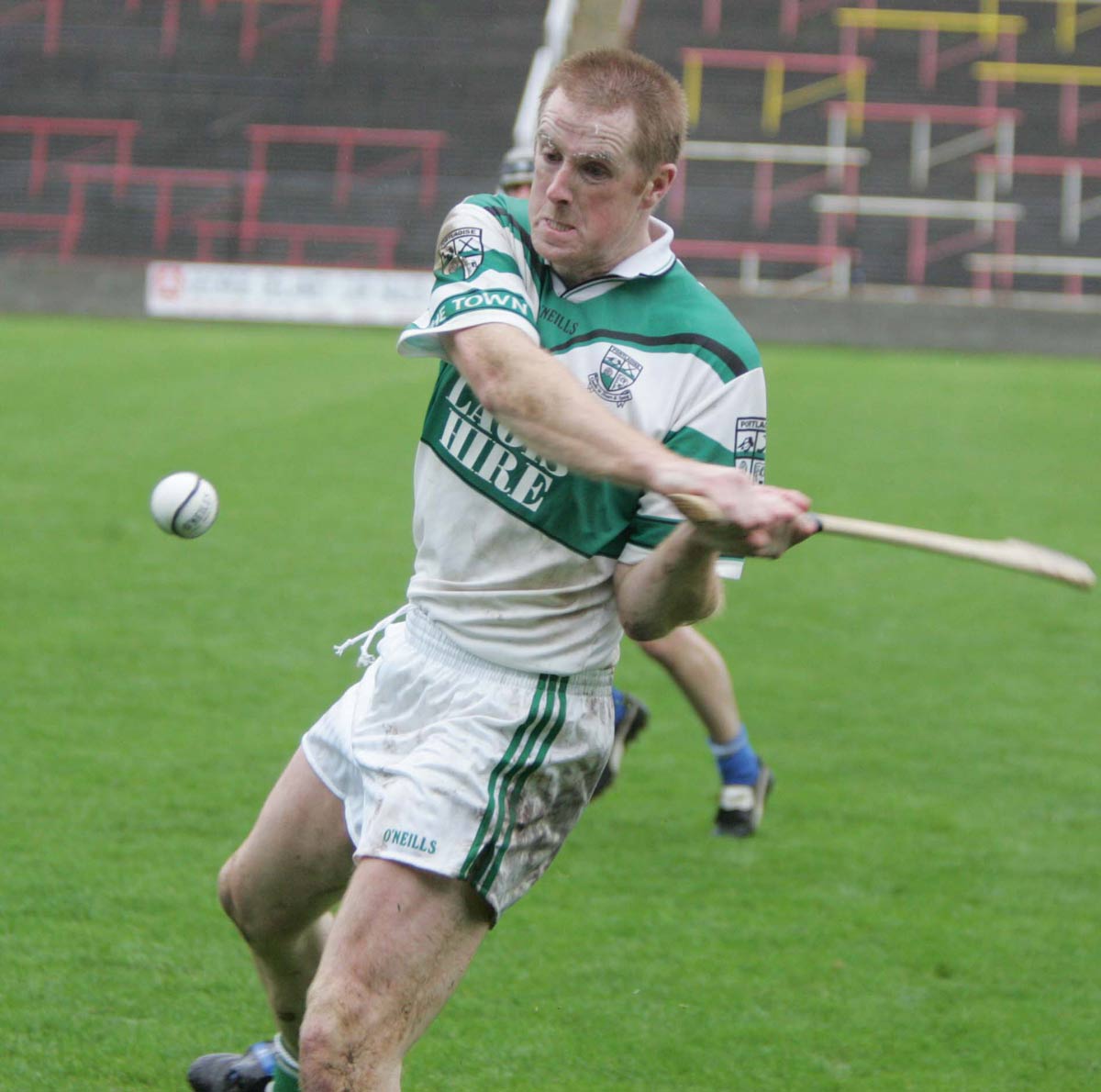
“Niall Rigney pictured in action during the county hurling final win in 2004.
Niall Rigney
Originally published: Town Tattler Vol 1 Issue 5
Tell us about the early days...
Growing up in St Brigid’s was just great. We were always on the go, never a dull moment, great neighbours. We were very lucky in that we were in the first row of houses built, number 4. We had the huge bonus of “the field” at our doorstep, now the all-weather leisure centre. We spent all of our time on the field, playing all sports, games of hurling, soccer, football, rugby, running races, tug of war etc.
Some years later a 400m running track was built around the field, which then developed our attention towards athletics. Very lucky we were indeed.
We lived in that field playing all the sports we could during the 70s. The street leagues, John Cole leagues, were played here. They were marvellous contests, great battles. If the truth be told, the career of many great Portlaoise and Laois players were started during the John Cole league era.
What were you like as a juvenile player?
I remember the Féile na nGael in Galway, and we were the Division 2 hurling winners. We had a very good team. Paul Bergin was the star, he scored 2-6 in the final against Lismore of Waterford. I was fairly average back then. I played in all the games but was dropped for the final.
When we got back to the GAA Centre that evening, the team was to parade around the hall with the cup, in their jerseys. I had left my jersey in a car and I remember asking if I could go get it and there was a throwaway comment, “why do you want it sure you weren’t playing.” Looking back now I know there was no harm meant at all but at the time I was so upset and I really think it affected my confidence when I was a juvenile player.
It probably just shows how careful we need to be when speaking to kids especially.
I played in a minor hurling final in 1985 at 16 and was taken off. Nervous, poor and very little confidence in my ability. I held onto that comment for a good while to motivate me to show that I was a decent, competitive player. Eventually my confidence grew and I developed real belief in myself as a player.
What was it like having brothers who played too?
In 1983, my brother Noel was full forward on the winning team on the three-in-a-row team against Camross in Mountrath. He scored a goal too and he also won a Leinster U21 hurling title that year against Wexford in Croke Park.
Having Noel win those, and bring those medals home to St Brigid’s was a huge influence on me. Noel was a very good player with a great attitude. He was quiet, but very determined if things got heated. He was also a very good rugby player. I often felt he was an easy target for selectors to make changes because he was so quiet in himself. Pity.
Who were your heroes growing up?
Watching the Town win those championships from 1981 to 1984 was huge for me. It gave me a love of hurling and a desire to want to win a senior title myself playing in the green and white of Portlaoise. All of those players were brilliant. They were the backbone of a very good Laois team in that era, so they were my heroes, without doubt.
What role did rugby play in your life?
I started playing rugby seriously when I was 18 or 19. I really only played rugby to keep myself fit and in good condition over the winter months, in order to be in good shape come the new GAA year.
As I got to 20 or 21, I showed a bit of talent and along with Noel we both were picked to play for the Leinster junior rugby team, and won the Inter-provincial championship that year, beating Ulster in the final in Ardee.
We were the first two brothers to do that. I was after winning a senior hurling and football double that year, 1991, and got an opportunity to play with Greystones senior rugby team. Both Des and Brian were already there, so I said I’d try have a go.
I knew I had an ability, but physically I was a bit behind for a number 8 forward. 6ft 2in and 15 stone was small for that position back then, but I was athletic, had decent hands and pace, but lacked the physicality at that time. I really enjoyed it and decided to have a serious go at it. I hoped to make the Leinster senior squad. I honestly decided to give up hurling and concentrate on rugby.
Disaster Strikes
None of that rugby mattered after 22 October 1991, while playing in the old Lansdowne Road against Wanderers RFC. A collapsed maul, me at the bottom, body gone one way, head stayed in a locked position. My rugby career was over. Three collapsed cervical vertebrae.
Afterwards, I was advised never to play again. I was devastated. All of my ambition to better myself and go higher up the ranks was over in one movement. I went into a very dark place for a long time.
If that happened a player today, they would receive huge support all round, both job-wise, physical and mental support, from professional people. I was offered none of these, just hard luck and move on.
After six or seven months I went back to play GAA, but I knew I wasn’t ready, as my heart wasn’t in it. The fear of a strong tackle, could it cause more damage and finish this career too, could I end up paralysed? These were the things going through my mind.
After a couple of years I eventually decided either to get back full on hurling or quit it altogether. Once my mind was made up I went at it and my confidence and ability grew on the GAA field. But often still, even today, 30 years on, I have some regret that I should have gone and got more support to help get over a life-changing injury. But they were different times.
It was only years later when I realised I had been suffering from depression, but not back then. If you said you weren’t feeling well, people would distance themselves from you. That is very sad really, but that was the way back then. People who never played, or went through that, would not understand unfortunately.
How was managing hurling royalty?
The only times I ever doubted myself was as that young player from 12 to 18 years old. I had huge belief in my ability later in life. Some players might think that is arrogance, but I think it was just belief that I was as good as their best player if tested.
Working with such players as Eoin Larkin and Jackie Tyrell, winners of multiple All-Ireland medals and captains of winning Kilkenny senior teams, was great. Great county players but huge club players too. The club is everything.
They knew I was honest, direct, organised, encouraging, hard when I needed to be, but caring about their needs and team preparation above all.
If you are anything other than that in a traditional county or club, they will see through you easily enough. I had a great respectful relationship with that club and panel of players. Great times.
How different is it managing a hurling and a football team?
I found no difference at all, because the fundamentals of both games are the very same. The only thing I will say about the Portlaoise senior football players is that they are brilliant lads, dedicated, honest, caring, great Portlaoise men, who love the jersey.
Nobody epitomises the commitment and dedication to our jersey more than Bruno McCormack and Kieran Lillis. For me, magnificent people, who love the town.
The future of the club?
The development of our players and teams should always be the priority, not lights, drainage or pitches. That is just my opinion.
We won an All-Ireland club title, numerous senior football and hurling doubles, minor and senior doubles in 1984, the centenary year. All that with two pitches and a clubhouse, poor lights later on, and for a long time, one pitch.
Unless we get back to this way of thinking, we are in trouble on the playing side. We need to encourage our young players and challenge our hurlers to make the step up and be extra competitive. Anything else is below our standards.
The fairway or the sideline in 2021?
I love looking at all sports, any sport during this Covid era, but that will pass and we will be back at games later in the summer.
I am back playing a little bit of golf in Portlaoise Golf Club after four years away from it. I am not that good, but I enjoy the chat and craic that goes with that.
I don’t see myself being on a sideline again soon to be honest. With my own club I am delighted to see the influx of new blood at executive level this year. Some great Town people on board and it feels like we might start all pulling together in the right direction.
People are in there with the right motives for the club and they need the support of all clubmen. Yes, facilities are important, but I want to see a real focus on us getting back competing to win senior championships in hurling, which needs real attention, and football in the near future.
Tom Bergin
I owe everything to Tom Bergin, Paul and Liam’s father, Aaron and Gary’s grandad. He was very good to me, he also knew I loved hurling, but he knew my confidence was low.
He would be very straight with me, if I needed a cop-on talk, Tom would tell me. As a young hurler we lived across the back lane in St Brigid’s. I would often go with Tom, doing his bread rounds, pipe smoke everywhere, chatting with him about matches and so on. I can still smell the pipe smoke.
In 1987 Tom took over the junior hurling team in the club, and he told me one day that “I’m going to play you midfield and you will be taking the frees also”. I was totally surprised, and began to doubt myself again. What if I let him down?
We won that junior championship and I was young, 18, and starting to get better and more confident. I scored seven or eight points in that final against Timahoe, with the great Jimmy Wrest as captain on the day. I played for the senior team that year also, and I was on the panel when we beat Clonad in the final.
That was the best Portlaoise hurling team I ever saw or played with. We lost the Leinster Club final by one point in Nowlan Park against Rathnure. Our footballers had beaten Parnells of Dublin in the Leinster Club football final. We were so close to being the first club to win the provincial club double. Incredible players on both teams.
I was captain of the winning U21 team against Camross in 1988 with Tom again as the manager. I owe Tom a huge thanks for helping me believe in myself that I could be a good competitive player. He made me captain of that U21 team. I didn’t realise until years later what Tom had actually done for me. It is a lovely trait in a person and mentor to do that for a young player low on confidence. He was the reason I became the hurler I was.
The best days?
Playing midfield in 1989 when winning the championship against Camross.
Getting man of the match in 1991, winning the championship against Clonad.
Getting man of the match and captain in 1998, winning the championship against The Harps.
Playing midfield in 2004, winning the championship against Castletown.
Slow to start, but a lot of good days too.
And the worst?
Losing a county final is just terrible. As great as it is to win them, it is the ones you lose that you think of most and have the biggest regrets from.
I played in and lost senior hurling finals in 1988, 1990, 1992, 1993, 1995 and 1999, and 1997 in football. Lost seven, won six. Not a great record you might say but I know a lot of players would give anything to have won six senior championships.
What was your time with Laois like?
I played for Laois from 1989 to 2002. But in truth I stayed on two years too long. Looking back I feel I had little to offer in my last two years.
It was enjoyable, and I loved to play with great Laois players like PJ Cuddy, Joe Dollard, Bill Maher, John Taylor, Paul Cuddy, Declan Conroy, Ricky Cashin and many more. Great players to share a dressing room with.
I grew into a county player who always wanted to test himself. I asked the manager countless times to put me on the opposition’s best player. I loved that test of ability. A lot of days it did not work out for me, but I think I handled myself okay against a lot of teams too.
We should have beaten Kilkenny in the semi-final in 1998, lost by three points. They won Leinster by nine. We could have won Leinster had we pushed on against the Cats that time.
Tell us about your time as a manager
The most enjoyable aspect of being a manager is seeing your players give complete effort in everything you ask of them. It is not always about winning. If you give every ounce of yourself as a player to be in the right mind and attitude, then every manager will respect you.
I always said to players, to give your supporters a team to support. Be honest with yourself and the players.
The stressful times are when dealing with people who are not 100 per cent committed. A player can easily hide from a manager and think he is fooling him in his actions off the pitch, but the player is only fooling himself and his teammates. On the big day, that dishonest player will always be found out.
From The Town to The Village...
When I left the Laois position in 2010, like a lot of intercounty managers in the same situation, I was very frustrated.
There were a few things: county board officials not caring if you ever won or lost a game, once your set-up wasn’t costing them too much beyond the miserable budgets they set; a couple of players who went off with their club mates a week before our last qualifier game and didn’t make the last Sunday session because of a drinking session; and myself for not dropping them from the panel and starting one of them, bringing the other on as a sub.
I resigned after that Carlow game in 2010, before I was asked to. Ninety per cent of the Laois lads were great committed players who maybe lacked the real belief that they were good enough, but they gave it their all with little proper support from the county board. Again, my opinion.
How did you get into football?
I was never serious about football until 1991. I remember the first round of the senior championship in Timahoe against St Joseph’s. Portlaoise were champions in 1990.
Portlaoise were poor on the night and were bullied by Joseph’s, who beat Portlaoise by 10 points. Joseph’s were rubbing it in all over the field and outside the wire too. Donal, my brother, got a nasty off-the-ball punch from an official on the Joseph’s sideline and nobody came to help him.
I was fuming. I went to see how he was after the game in the dressing room and Mick Lillis asked me would I play with them. No problem, I wanted and waited for Joseph’s all year. It didn’t happen.
We beat a young Portarlington team in the final that year. I was midfield with Carl Lenihan. Great win. To win that playing football with Tom and Nodsey Prendergast, Colm and Gerry Browne, Mick Lillis, Cyril and Liam Duggan was great. Tony Dunne was brilliant that day for Portlaoise. He was a gifted athlete, could play any sport easily. That was their last one to win, except Cyril in 1999. Pity it was not Joseph’s though, I often thought.
I played midfield in 1997 against Stradbally, when we had six or seven of the All-Ireland winning minor team from 1996 playing. Stradbally beat us by six points. They deserved the win. I scored two points from play in that final from midfield. I wasn’t a good player, but I could do the job asked of me.
What was disappointing was the 13-week wait between semi-final and final. Stradbally used the excuse they had a player on their panel on the Laois minor panel and refused to play, even though he wasn’t next or near their starting team.
The truth was Tony Maher had a groin operation after their semi-final and it took a three-month recovery period in order for him to play the final. I felt the club should have been stronger in dealing with the County Board at that time.
Cyril Duggan was captain of that team. Had it been the normal two-to-three week gap between games, Cyril would have captained Portlaoise to a senior county title. No doubt in my mind.
Did you get hard knocks?
I became very driven in the mid-90s. We lost county finals in 1992, 1993 and 1995. A good Camross team beat us in the semi-final in 1996, they went on to win the Leinster Club title. We lost to a good Castletown team in the semi-final in 1997, they should have won Leinster, and lost a replay to Birr.
A few Portlaoise players were not giving their all, I felt, and had dropped the standards set and shown to us by the great teams of the 80s.
If a fella was not doing his job, and maybe management were not telling him, it led me to feel that lads were taking the easy option, rather than working like dogs for the team.
I decided, as a committed outfield player, that I was going to tell that type of player the truth. I wanted to win county championships for the Town, simple as that.
I was wrong at times, confronting players, but I just really wanted the team to be the best they could be and for me to be the best player I could be too.
I never fell out with any Portlaoise player permanently, even if they fell out with me.
Persistence pays off?
We eventually got a great group of honest, decent and committed players playing again for Portlaoise senior hurlers.
I was captain in 1998 when we beat The Harps in the county final and I was at the top of my game, very fit, injury-free and very determined.
We did not have a great hurling team. The lads on that team usually say that about themselves, but our work rate for each other was massive. Honesty in every player won that championship.
We focused on training our minds and bodies to hook and block the opposition at all times. We got to a Leinster final and beat the Kilkenny champions along the way. That was a great year. Great lads to play with.