
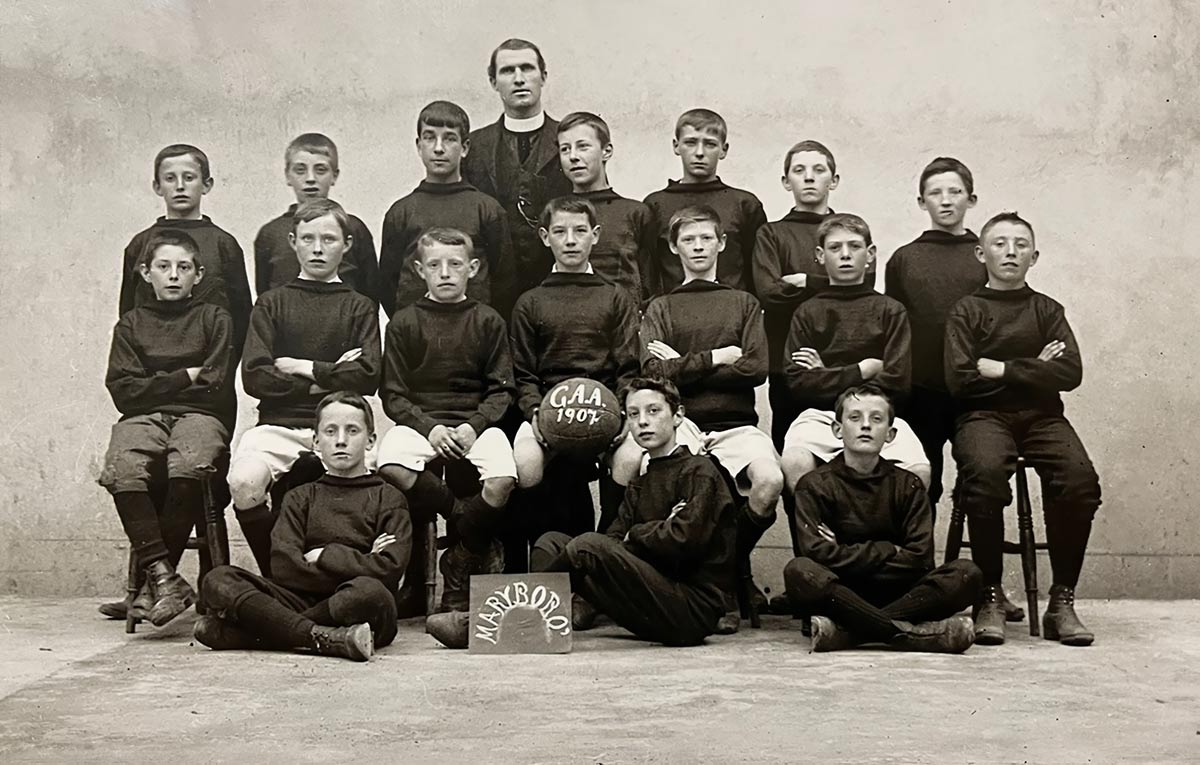
Fr Kearney pictures with a juvenile Maryboro' (Portlaoise) teamn from 1907.
Fr. J.J. Kearney
Fr. J. J. Kearney was a man that will always hold a special place in the history of Portlaoise and Laois GAA. A popular curate in Portlaoise in the early decades of the last century, he supported the Gaelic revival and particularly the growth of the infant GAA. In Laois county terms his legacy includes playing a central role in the acquisition of the grounds for the GAA where Pairc Ui Mhordha now stands. Also as a very active Chairman of the County Board, he was the driving force behind the team that won the AllIreland hurling final of 1915, which (sadly) remains the only All-Ireland at senior level won by a Laois county team. The grounds were first acquired for the Portlaoise club to cater for the sporting needs of the young men of the town. While the “Town” quickly established itself in the world of Gaelic Football at county and national level – their winning of the Leinster semi-final and final on the same day is an achievement that stands loftily alone in the record books and will never be equalled – it was the promotion of hurling that was Fr. Kearney’s priority. He organised the games in the local CBS and in the schools of the county through very successful leagues and in juvenile activities. Having a place dedicated to the playing of the games was very important to him and while the county benefitted from his vision, the local club still had open access to the grounds and so benefitted too. It was appropriate that Portlaoise’s first home of its own was acquired adjacent to Pairc Ui Mhordha in a deal with Laois County Board in the late 1970s.
My father, Joe (Fennelly), was a young man playing the games during the good priest’s tenure in the town. He was a great admirer of Fr. Kearney, who was county chairman from 1910 to 1916 and was club chairman for most of the time he ministered in the parish. He often told me how he would encourage the young lads to come to the park by dishing out apples and oranges and other goodies to those who came. Such an enlightened approach must surely be a lesson for those who preferred the heavy-handed and threatening approach and who insisted rather than encouraged participation.
His interest in hurling and his organisational skills were affirmed by no less a man than that great Laois hurling warrior of old, Jack Carroll. Jack was captain, which at the time was chairman and leader all wrapped into one, of one of the top Laois clubs, Kilcotton, for an incredible 25 years. He was also captain of the Laois team that played in the 1914 All-Ireland final, and was the senior player in the famous victory of 1915. Jack told me that the win was all down to Fr. Kearney, who organised sessions of collective training, the use of the best coaching methods of the day and the top trainer, the legendary “Drug” Walsh of Kilkenny fame. He was a man well ahead of his time.
The quality of Fr. Kearney’s organising abilities are borne out by newspapers of the period and letters in the Higgins archive which was purchased by the GAA some years ago and is now in the GAA Museum in Croke Park. John J. Higgins, who ran a family drapery business at Lower Main Street for many years, was a close friend and ally of Fr. Kearney. He was a prominent member of Laois GAA Board, the Laois delegate to the Leinster Council, and was in charge of the training funds set up to assist the training of the county teams. The archive contains letters from various people involved in Laois GAA at the time, including some from Fr. Kearney and Bob O’Keeffe, a county hurling stalwart of 1914 and ’15 and later to become President of the GAA (1935-’38), the only Laoisman to hold the office until Liam O’Neill became President in 2012.
Fr. Kearney came to Portlaoise (then Maryborough) as a young curate in 1896 and served for twenty years in the town. In 1916 he was transferred to Newbridge before becoming parish priest in Daingean, Co. Offaly, in 1924. In 1933 he became parish priest in Edenderry where he died unexpectedly in 1936 and where he is buried. His care and enthusiasm for the pastoral and social needs of his flock is still dearly remembered despite the passing of years in the parishes in which he served. He deserves to be particularly dearly remembered in Portlaoise, where his love for Gaelic Games and pride in the town club and his adopted county was embraced by the locals and where his spirit of sporting achievement prevails to this very day.